
Indian Compliance
Selling Plywood in India? Why the New BIS Quality Control Order Changes Everything

The Indian real estate and interior design sectors are booming, but with rapid growth comes the critical need for safety, durability, and standardized quality. To ensure that the foundation of our homes and offices remains uncompromising, the Ministry of Commerce and Industry (DPIIT) has rolled out the Plywood and Wooden Flush Door Shutters (Quality Control) Order.
If you manufacture, import, or sell plywood and flush doors in India, the regulatory landscape has officially changed. The Bureau of Indian Standards (BIS) has made the ISI Mark mandatory for these products. Operating without it is no longer just a quality oversight—it is a legal violation.
Whether you are navigating BIS regulations for timber, managing Legal Metrology (LMPC) compliance for packaged commodities, or handling FSSAI for broader commercial operations, understanding these mandatory frameworks is essential for uninterrupted business. Let’s dive into everything you need to know about the mandatory BIS certification for plywood and flush doors, including the latest timeline updates and compliance steps.
Latest Updates: 2025 & 2026 Compliance Deadlines
The government has adopted a staggered approach to ensure that businesses of all sizes have adequate time to transition to the new mandatory ISI marking rules. According to the latest notifications from the DPIIT, the final enforcement dates for mandatory compliance are based on enterprise size:
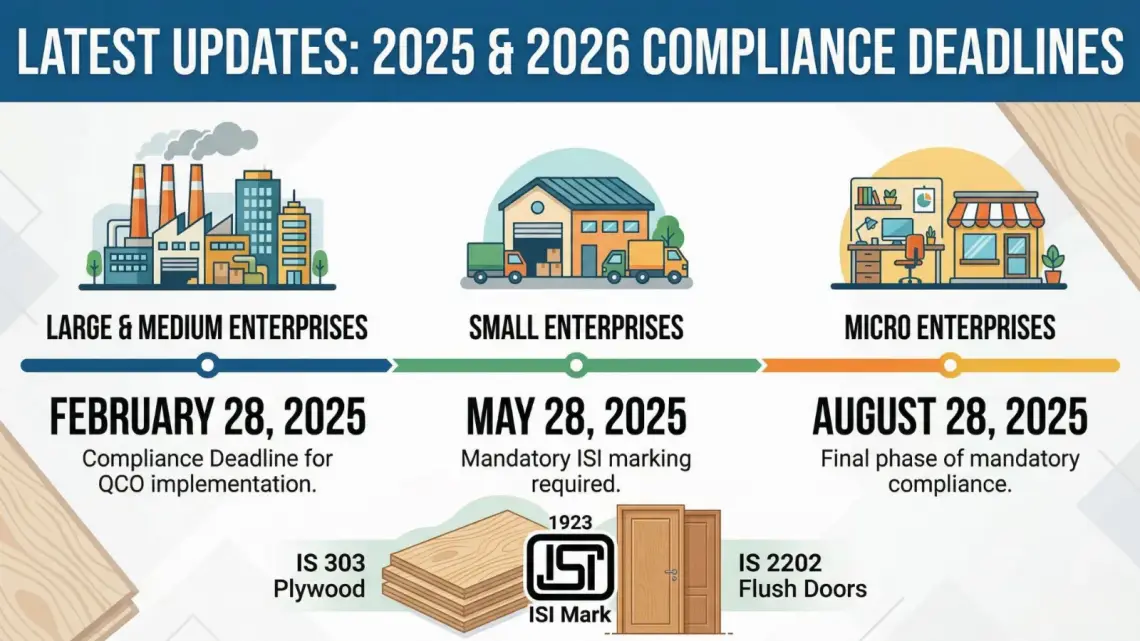
- Large & Medium Enterprises: February 28, 2025
- Small Enterprises: May 28, 2025
- Micro Enterprises: August 28, 2025
2026 DPIIT Transitional Exemption (Recent Update)
In a major relief for importers announced in February 2026, the DPIIT issued a notification simplifying compliance for transitional shipments. Imports of products covered under these QCOs are temporarily exempt from mandatory BIS compliance only if:
- The Purchase Order was issued before the QCO implementation date.
- The Bill of Lading and Bill of Entry are filed within 180 days from the QCO's enforcement date.
Note: Goods manufactured exclusively for export are exempt from this Quality Control Order.
What Products and IS Standards are Covered?
The QCO encompasses a wide variety of engineered wood products. To legally sell these in India, they must conform to their specific Indian Standard (IS) and bear the ISI mark under Scheme-I of the BIS (Conformity Assessment) Regulations.
Here is a breakdown of the key products and their corresponding IS codes:
1. Plywood for General Purposes (IS 303: 1989)
The most common engineered wood used in furniture, partitions, and packaging. To get the ISI mark, the plywood must pass rigorous tests for bonding strength, moisture resistance, and dimensional stability.
2. Wooden Flush Door Shutters - Solid Core Type (IS 2202 Part 1 & Part 2)
- IS 2202 (Part 1): 1999 – Covers solid core flush doors with plywood face panels.
- IS 2202 (Part 2): 2022 – Covers solid core flush doors with particle board, MDF, or HDF face panels.
3. Marine Plywood (IS 710: 2010)
Used in environments with high moisture exposure (like kitchens, bathrooms, and shipbuilding). BIS testing ensures this plywood can withstand boiling water and extreme humidity without delaminating.
4. Veneered Decorative Plywood (IS 1328: 1996)
Premium plywood surfaced with thin decorative wood veneers. Mandatory certification ensures consistent aesthetic quality, safety, and durability for high-end cabinetry and wall paneling.
5. Cellular and Hollow Core Flush Doors (IS 2191 Part 1 & 2: 2022)
Lightweight doors used primarily for interior residential spacing. The standards dictate the core strength, impact resistance, and facing quality.
Why is the ISI Mark Mandatory for Plywood?
You might wonder why the government is strictly enforcing this QCO. The reasons go far beyond bureaucratic red tape:
- Consumer Safety & Trust: The ISI mark guarantees that a flush door won't warp in the monsoon or that plywood won't collapse under standard structural weight.
- Eradicating Substandard Imports: The Indian market was previously flooded with cheap, low-grade wood products that degraded quickly. The mandatory BIS mark ensures a level playing field where both domestic manufacturers and foreign importers must meet the same high standards.
- Tender Eligibility: If you want to supply plywood or doors to government projects, railways, or large institutional builders, an ISI-marked product is a non-negotiable prerequisite.
Step-by-Step BIS Certification Process
Achieving BIS certification can seem daunting, but breaking it down into a systematic process makes it entirely manageable. Here is the roadmap to getting your ISI mark:
Step 1: Document Preparation
Gather all necessary documentation, including factory registration (KYC), plant layout, manufacturing process flowcharts, and details of raw materials.
Step 2: In-House Testing Facility Setup
BIS Scheme-I requires manufacturers to have a fully equipped, calibrated in-house testing laboratory to conduct day-to-day quality checks as per the relevant IS standard.
Step 3: Product Testing at a BIS-Recognized Lab
Before applying, you must send product samples to an independent, BIS-accredited laboratory. The test report generated here will form the core of your certification application.
Step 4: Application Submission & Factory Inspection
Submit the application along with the test reports via the BIS portal. Once reviewed, BIS will assign an auditor to visit your manufacturing facility. The auditor will inspect the production process, verify the in-house lab, and draw random samples for parallel testing.
Step 5: Grant of License
If the factory inspection is successful and the independent samples pass all tests, BIS will grant the license, allowing you to legally affix the ISI mark on your plywood and flush doors.
Severe Penalties for Non-Compliance
Ignoring the Quality Control Order is a massive risk. The Bureau of Indian Standards Act, 2016, empowers authorities with strict enforcement protocols. If a business is caught manufacturing, importing, storing, or selling notified wood products without a valid ISI mark after the deadline, they face:
- Immediate Seizure: Confiscation of the entire non-compliant stock.
- Heavy Financial Fines: Monetary penalties that compound based on the volume of the illegal goods.
- License Suspension: Cancellation of any existing trade licenses.
- Imprisonment: Up to two years in jail for the directors/owners of the non-compliant entity.
Frequently asked questions
What is the final deadline for small enterprises to get BIS certification for plywood?
Small enterprises must obtain mandatory BIS certification for plywood and flush doors by May 28, 2025. Operating without the ISI mark after this date is entirely illegal.
Are imported wooden flush doors exempt from the BIS Quality Control Order?
No, imported wooden flush doors must comply with the BIS QCO. However, a temporary 2026 exemption exists for transitional shipments if specific purchase order and filing conditions are met.
Which IS standard applies to general-purpose plywood?
General-purpose plywood must conform to the IS 303 standard. To receive the ISI mark, it undergoes rigorous testing for moisture resistance, dimensional stability, and bonding strength.
What happens if I sell plywood without the ISI mark after the deadline?
Selling non-compliant plywood after the deadline can result in immediate stock seizure, heavy financial penalties, trade license suspension, and potential imprisonment for the business owners.
Do I need an in-house testing lab for BIS certification?
Yes, under BIS Scheme-I, manufacturers must establish a fully equipped, calibrated in-house testing laboratory to conduct daily quality checks according to the relevant Indian Standard.