
Global Compliance
Question” (Good for Clicks) Is MSDS Obsolete? Everything You Need to Know About the Shift to SDS

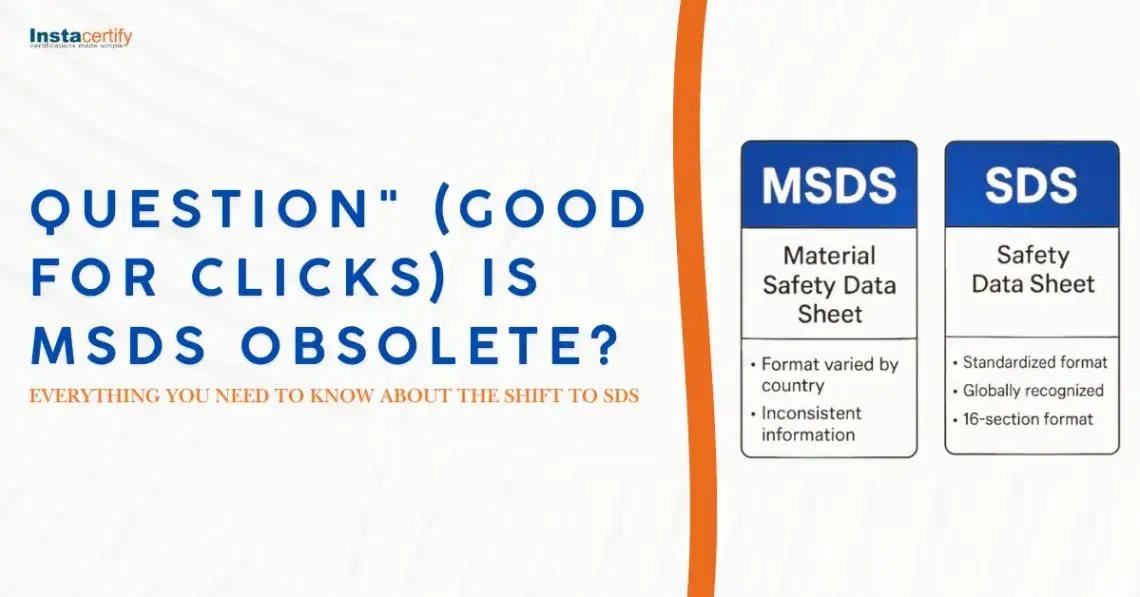
At its core, a Material Safety Data Sheet (MSDS)—now more commonly referred to as a Safety Data Sheet (SDS)—is a detailed informational document prepared by a chemical manufacturer or importer.
Think of it as a “user manual” for a chemical product. While a product label gives you immediate warnings (like “Flammable” or “Causes Skin Irritation”), the SDS provides the deep-dive technical data necessary for safe handling, storage, and emergency response.
It tells employers what risks their workers face, tells employees how to protect themselves, and tells firefighters what to do if the chemical is involved in a blaze. In many jurisdictions, including the United States (under OSHA) and the European Union (under REACH), having these documents accessible to employees is a strict legal requirement.
Is MSDS Replaced by SDS?
Yes, absolutely. This is the most important recent development in chemical safety.
Historically, different countries (and even different companies) used various formats for their MSDSs. An American MSDS might look completely different from a Japanese one for the exact same chemical, making it difficult to find crucial information quickly during an emergency.
To solve this, the United Nations developed the Globally Harmonized System of Classification and Labelling of Chemicals (GHS).
GHS standardized hazard communication worldwide. As part of this adoption, the old, varied “Material Safety Data Sheet” (MSDS) was replaced by the standardized 16-section “Safety Data Sheet” (SDS).
While many people still use the term “MSDS” out of habit, the correct, legally compliant term today is SDS.
What’s the Difference Between SDS and MSDS?
While both documents serve the same ultimate goal—safety—their structure is the primary difference.
- The Old MSDS: There was no single standard format. They could vary in length from one page to ten. Information like first-aid measures might be found at the top of one document but buried at the bottom of another.
- The New SDS: Under the GHS standard, every SDS must follow a strict 16-section format in a specific order. This ensures that if a spill occurs, an emergency responder knows exactly which section to flip to for containment procedures, regardless of where the chemical originated.
The SDS is also more prescriptive in its language, using standardized hazard statements rather than vague descriptions.
Can I Create My Own MSDS/SDS?
The short answer is: Yes, but it is highly risky and generally not recommended unless you are a qualified expert.
If you are the manufacturer of a chemical mixture (even if you are just diluting a concentrate and reselling it under a new label), you are legally responsible for authoring the SDS.
However, creating a compliant SDS is a complex scientific and legal undertaking. It requires:
- Deep knowledge of chemistry and toxicology.
- Understanding how different ingredients in a mixture interact to change hazards.
- Up-to-date knowledge of international regulations (GHS, OSHA, CLP, etc.).
If you author an incorrect SDS and an accident occurs, your company could face severe legal liability and massive fines. Most businesses outsource this task to specialized authoring services or use robust authoring software.
How Many Categories of MSDS Are There?
This is a common point of confusion. There aren’t different “categories” of the MSDS document itself (e.g., Type A vs. Type B documents). There is only one standard SDS format.
However, within that document, chemicals are classified into three major GHS Hazard Categories:
- Physical Hazards: E.g., Flammability, explosives, gases under pressure, oxidizing liquids.
- Health Hazards: E.g., Acute toxicity, skin corrosion, carcinogenicity, respiratory sensitization.
- Environmental Hazards: E.g., Aquatic toxicity (acute and chronic).
The SDS will clearly state which of these hazard categories apply to the specific product.
Understanding H-Statements and P-Statements
When reviewing a modern SDS (specifically in Section 2: Hazard Identification), you will see cryptic codes combined with phrases. These are crucial elements of the GHS standard.
H-Statements (Hazard Statements):
These describe the nature and degree of the hazard. They are standardized phrases assigned to specific hazard classes.
- Example: H225 – Highly flammable liquid and vapor.
- Example: H301 – Toxic if swallowed.
P-Statements (Precautionary Statements):
These provide measures to minimize or prevent adverse effects from exposure or improper storage. They cover prevention, response, storage, and disposal.
- Example (Prevention): P210 – Keep away from heat/sparks/open flames/hot surfaces. – No smoking.
- Example (Response): P303 + P361 + P353 – IF ON SKIN (or hair): Take off immediately all contaminated clothing. Rinse skin with water/shower.
These codes replace older, less standardized “R-phrases” (Risk) and “S-phrases” (Safety).
What Are the 16 Points (Sections) in an SDS?
A GHS-compliant SDS must contain these 16 sections in this exact order:
- Identification: Product name, manufacturer contact info, and emergency phone numbers.
- Hazard(s) Identification: Signal words, pictograms, and H/P statements.
- Composition/Information on Ingredients: Chemical names and concentrations.
- First-Aid Measures: Immediate treatment for different routes of exposure (inhalation, skin contact, etc.).
- Fire-Fighting Measures: Suitable extinguishing media and special protective equipment needed.
- Accidental Release Measures: Procedures for containment and cleanup of spills.
- Handling and Storage: Safe practices for handling and conditions for safe storage.
- Exposure Controls/Personal Protection: Exposure limits (like PELs or TLVs) and required PPE (gloves, respirators).
- Physical and Chemical Properties: Appearance, odor, pH, flash point, boiling point, etc.
- Stability and Reactivity: Information on chemical stability and hazardous reactions.
- Toxicological Information: Detailed descriptions of health effects from exposure.
- Ecological Information: Environmental impact (aquatic toxicity, degradability). (Non-mandatory for OSHA, but required by GHS).
- Disposal Considerations: Instructions for safe disposal of waste. (Non-mandatory for OSHA).
- Transport Information: Shipping regulations (DOT, IATA, IMDG). (Non-mandatory for OSHA).
- Regulatory Information: Specific safety, health, and environmental regulations. (Non-mandatory for OSHA).
- Other Information: Date of preparation or last revision.
What Are the 5 Items That an MSDS Sheet Must Include?
Under the old MSDS formats, requirements were looser, but authorities generally demanded five core pillars of information to ensure basic safety. While the modern SDS requires all 16 sections above, these five historical elements remain the most critical for immediate workplace safety:
- Chemical Identity: What is the product?
- Hazardous Ingredients: What dangerous components are inside it?
- Physical and Chemical Characteristics: What does it look/smell like, and does it burn?
- Fire and Explosion Hazard Data: How do you put it out if it ignites?
- Health Hazard Data & First Aid: How does it hurt people, and how do you treat them immediately?
Today, a compliant SDS covers these five points comprehensively across Sections 1 through 5.
Benefits of Obtaining MSDS/SDS
Maintaining an accurate library of SDSs isn’t just about avoiding fines; it offers tangible operational benefits:
- Enhanced Workplace Safety: Employees know the risks they face and how to wear the correct PPE, reducing accidents and long-term illnesses.
- Effective Emergency Response: In the event of a spill or fire, rapid access to SDSs allows responders to choose the right foam, extinguishers, or medical treatments, potentially saving lives and facilities.
- Regulatory Compliance: Avoids costly fines from bodies like OSHA, EPA, or DOT.
- Liability Protection: Demonstrating due diligence in communicating hazards can protect a company during legal disputes related to exposure.
If you want to MSDS SDS please visit: MSDS Authoring
Why Use Software for Chemical Management and Product Compliance?
In the past, companies kept dusty 3-ring binders filled with paper MSDSs. This method is now obsolete and dangerous.
A medium-sized company might have thousands of chemicals. Manually tracking revision dates, ensuring every employee has access to the newest version, and cross-referencing chemical inventory against regulated substance lists is nearly impossible without technology.
Chemical management software solves this by:
- Centralizing Data: Providing a digital, searchable cloud-based library accessible via mobile devices.
- Automating Updates: Automatically fetching the newest SDS from manufacturers when they are revised.
- Simplifying Reporting: Generating necessary regulatory reports (like Tier II reporting) with a few clicks based on SDS data.
- Translation: Instantly translating SDSs into the native languages of a diverse workforce.
In the modern regulatory environment, relying on paper binders is a compliance risk you cannot afford to take.
