Indian Compliance
Safety of IT and AV Products: A Complete Guide to IS/IEC 62368-1:2023 Testing
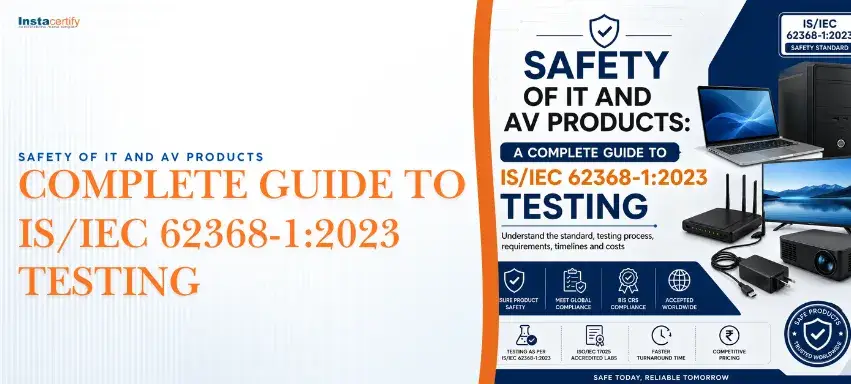
Every laptop on a desk, every monitor on a wall, every router blinking in a server room carries stored electrical energy, generates heat, and sits within arm’s reach of people who know nothing about its internals. Product safety testing exists for exactly this reason: to prove, with evidence, that a device will not shock its user, start a fire, burn a hand, or injure anyone under both normal use and foreseeable fault conditions.
For audio/video, information technology and communication equipment, the single standard that governs this worldwide is IEC 62368-1 — adopted in India as IS/IEC 62368-1:2023. This guide explains what the standard is, which products it covers, what actually happens during testing, why it must be done in an accredited laboratory, and what manufacturers and importers should budget in samples, time and money.
Which Products Fall Under IS/IEC 62368-1?
The scope is deliberately broad — it covers electrically operated audio/video, information and communication technology equipment, and office machines, with a rated voltage not exceeding 600 V. In practical terms:
- Computing and networking products: servers, PCs and automatic data processing machines, routers, notebook/laptop computers, tablets and their power supplies and adapters
- Consumer electronics: amplifiers, home theatre systems, digital cameras and personal music players
- Displays and display units: visual display units, computer monitors, televisions and digital projectors
- Telecommunication products: network infrastructure equipment, cordless and mobile phones, and similar communication devices, including battery-powered devices
- Office appliances: copiers, document shredders and similar office machines
- Similar audio/video, information and communication technology equipment used in homes, schools, data processing centres, and commercial and professional environments
What is IEC 62368-1:2023?
IEC 62368-1:2023 (Edition 4, published May 2023) is the international product safety standard for audio/video, information and communication technology equipment. In the standard’s own words, it classifies energy sources, prescribes safeguards against those energy sources, and provides guidance on the application of, and requirements for, those safeguards. The prescribed safeguards are intended to reduce the likelihood of pain, injury and, in the case of fire, property damage.
What makes 62368-1 different from the older standards it replaced — IEC 60950-1 for IT equipment and IEC 60065 for audio/video apparatus — is its hazard-based safety engineering (HBSE) philosophy. Instead of prescribing constructions product by product, the standard asks three questions of every design: what energy sources exist inside the product, how much harm could each cause, and what safeguards stand between that energy and the human being (or combustible surroundings)?
Energy Sources The Standard Controls
Energy source | What it covers | Everyday examples |
ES — Electrical energy | Voltages and currents capable of causing electric shock | Mains input, power supply outputs, USB/data ports |
PS — Power / fire | Electrical power capable of starting or sustaining a fire | Internal circuits, batteries, power conversion stages |
MS — Mechanical energy | Moving parts, sharp edges, falling or unstable equipment | Fans, moving assemblies, wall-mounted displays |
TS — Thermal energy | Hot accessible surfaces that can cause burns | Adapter housings, laptop undersides, projector vents |
RS — Radiated energy | Optical and acoustic radiation | Laser projectors, LEDs, headphone sound pressure |
Three Classes, Escalating Safeguards
Each energy source in the product is classified by severity, and the class dictates how many safeguards must protect the user:
Class | Meaning | Safeguard expectation |
Class 1 | Not painful, though possibly detectable | May be accessible to an ordinary person |
Class 2 | Painful, but not an injury | At least one safeguard between the source and an ordinary person |
Class 3 | Capable of causing injury (or, for PS3, a large fire) | Two independent safeguards — basic plus supplementary, or one reinforced safeguard |
Safeguards can be physical (insulation, enclosures, barriers), behavioural (instructions, markings) or built into the equipment (interlocks, protective earthing, current limiting). The standard also distinguishes between ordinary persons, instructed persons and skilled persons — a data-centre technician may be permitted access to energy levels a home user must never touch.
What Changed in Edition 4 (2023)?
Edition 4 introduced several changes that matter commercially:
- Legacy component acceptance removed. Components and subassemblies approved only to the old IEC 60950-1 or IEC 60065 — typically power supplies and mainboards — can no longer be accepted without additional evaluation to 62368-1. Manufacturers relying on legacy-certified parts must have them re-assessed.
- New requirements for external circuits, including a new table covering data connections and clarified treatment of antenna connections.
- Expanded battery-related requirements and new and clarified definitions (audio amplifiers, liquid cooling and coolants, charging temperature limits for secondary lithium batteries), reflecting how products are actually built today.
- Wider applicability of liquid-cooling assessments, with pressurized liquid filled cooling systems now evaluated regardless of coolant volume.
Indian Regulatory Picture: BIS CRS Now Points to IS/IEC 62368-1:2023
In India, most of these product categories are covered under the Compulsory Registration Scheme (CRS) administered by BIS under MeitY’s Electronics and Information Technology Goods (Requirement of Compulsory Registration) Order. No covered product may be manufactured, imported, stored or sold in India without BIS CRS registration based on a test report from a BIS-recognized laboratory.
The safety standards underneath CRS have now formally changed. By an amendment dated 7 November 2025 to statutory order S.O. 1248(E), the legacy Indian standards IS 13252 (Part 1):2010 (IT equipment safety, the twin of IEC 60950-1) and IS 616:2017 (audio/video apparatus safety, the twin of IEC 60065) are replaced by IS/IEC 62368-1:2023. A concurrent transition period allows the old standards to remain valid alongside the new one until 1 November 2028, after which IS 13252 and IS 616 stand withdrawn.
The practical message for manufacturers and importers: any new product development, new CRS registration or renewal strategy should be built around IS/IEC 62368-1:2023 now, not around standards that are already on their way out.
What Does Safety Testing Under 62368-1 Actually Involve?
A full evaluation combines construction review, measurement and deliberately induced abuse. A typical test programme includes:
- Energy source classification and safeguard evaluation: mapping every ES/PS/MS/TS/RS source in the product and verifying the required safeguards exist
- Electric shock protection: accessibility checks with test probes, insulation resistance, electric strength (hi-pot) testing, touch current and protective earthing continuity
- Heating tests: running the product at rated load and measuring temperatures on windings, components and every accessible surface against burn-injury limits
- Abnormal operation and single-fault testing: blocking vents, stalling fans, shorting outputs, overloading circuits and simulating component failures to confirm the product fails safely, without fire or shock hazard
- Fire enclosure and material flammability assessment: verifying potential ignition sources are contained and enclosure materials meet the required flammability ratings
- Mechanical tests: stability (tip-over), impact, drop, stress relief on enclosures, and sharp-edge checks
- Battery-powered device evaluation: charging/discharging safety and protection circuits for products with secondary lithium cells
- Markings, warnings and instruction review: because instructional safeguards are safeguards too, ratings labels and safety instructions are checked as part of compliance
The output is a detailed test report — typically in CB-style format — recording the product’s construction, critical components, measured results and pass/fail verdicts clause by clause.
Why safety testing matters — and why big buyers demand it
For any new instrument or device, safety testing is the difference between assuming a product is safe and proving it. Prototypes that work perfectly on a bench can still carry an insulation gap that fails at altitude, a surface that exceeds burn limits after two hours at full load, or a power stage that ignites when a single component shorts. Testing finds these before your customers do.
It is also a commercial gate, not just a legal one. Major brands, OEM buyers, government tenders and large distributors routinely make a valid safety test report — from an accredited laboratory — a precondition of doing business, for three hard-headed reasons:
- Liability and recalls: A safety incident traced to an untested product exposes the buyer to product liability claims, recall costs and regulatory penalties. The test report is their evidence of due diligence.
- Brand protection: A charger that overheats or a display that tips over makes headlines with the brand’s name on it, not the component supplier’s. Buyers push the burden of proof down the supply chain.
- Market access: The same 62368-1 evidence underpins BIS CRS registration in India, CE marking in the EU (via EN IEC 62368-1), NRTL approvals in North America (UL/CSA 62368-1) and the IECEE CB Scheme — so one properly built report opens many doors.
- Samples and timelines: what to plan for
- Samples: Plan for 2–4 production-representative samples of the complete product for a typical evaluation — at least one unit for non-destructive measurements and construction review, and additional units for abnormal, fault and mechanical tests, which can be destructive. Complex products, product families with multiple models, or programmes that include battery evaluation may need more, plus critical component samples and datasheets.
- Documentation: Circuit diagrams, PCB layouts, a critical component list with certifications, ratings labels and user instructions should accompany the samples — incomplete documentation is the single most common cause of delay.
- Timelines: A straightforward product with complete documentation typically completes testing in 3–6 weeks; complex equipment, multiple models or findings that require design fixes and retesting can extend this to 8 weeks or more. For BIS CRS, add the registration processing time after the test report is issued — so the smart move is to start testing well before your launch or shipment date.
Why the laboratory’s accreditation is non-negotiable
A 62368-1 report is a technical-legal document, and its value depends entirely on who issued it. ISO/IEC 17025 is the international standard for the competence of testing and calibration laboratories — it requires demonstrated technical competence of personnel, calibrated and traceable equipment, validated methods and impartial operation, all verified through independent assessment and audits. A report from an ISO/IEC 17025 accredited laboratory carries recognition across borders through ILAC mutual recognition arrangements; a report from an unaccredited bench does not, and buyers, certifiers and regulators will reject it.
In India the requirement is explicit: testing for BIS CRS registration under IS/IEC 62368-1:2023 is mandatory and must be performed in a BIS-recognized, NABL-accredited laboratory (NABL being India’s national accreditation body operating to ISO/IEC 17025). Reports from any other source are simply not accepted for registration. Choosing the right accredited lab at the outset — one whose scope actually covers IS/IEC 62368-1:2023 and your product category — is therefore the first real compliance decision in the project.
How Instacertify helps
Instacertify arranges IS/IEC 62368-1:2023 safety testing through its network of ISO/IEC 17025 accredited partner laboratories — including BIS-recognized, NABL-accredited facilities for CRS in India — matching your product to the lab whose scope, capacity and recognition fit your target market. Partner-lab pricing is highly competitive: across major markets, safety testing to this standard typically runs from USD 600 to USD 1,500 per model, depending on the product’s size and type — a compact adapter or media player sits near the lower end, while a large display, server or projector with batteries and complex power stages sits toward the upper end. From test-plan advice and sample logistics to report review and BIS CRS filing, a dedicated Instacertify project manager keeps the whole process on schedule.
Get an exact quotation and timeline for your product.
Frequently asked questions
Is IS/IEC 62368-1:2023 testing mandatory in India?
Yes, for products covered under the BIS Compulsory Registration Scheme (CRS). Following the 7 November 2025 amendment, IS/IEC 62368-1:2023 replaces IS 13252 (Part 1):2010 and IS 616:2017, with a concurrent transition until 1 November 2028. Testing must be done at a BIS-recognized, NABL-accredited laboratory.
How many samples are needed and how long does testing take?
Typically 2–4 complete production-representative samples plus critical component documentation. Straightforward products complete testing in about 3–6 weeks; complex or multi-model programmes take longer, plus BIS registration processing time afterwards.
What does 62368-1 safety testing cost?
Through Instacertify’s accredited partner laboratories, safety testing to this standard typically ranges from USD 600 to USD 1,500 depending on the product’s size and type, with an exact quotation confirmed up front for your specific product and target market.
My power supply is certified to IEC 60950-1. Is that still acceptable?
Under Edition 4 (2023), components and subassemblies approved only to the legacy IEC 60950-1 or IEC 60065 are no longer accepted without additional evaluation to 62368-1. Plan for re-evaluation of legacy-certified components when moving to the current standard.
Can one test report serve multiple markets?
Largely, yes. IEC 62368-1 is the common technical basis for BIS CRS (India), CE marking (EU), NRTL approvals (North America) and the IECEE CB Scheme. National differences exist, but a well-constructed report from an ISO/IEC 17025 accredited lab is the foundation for all of them.