Indian Compliance
What is UN 38.3 Testing? A Complete Guide for Lithium Battery Manufacturers & Importers (2026)
Lithium batteries have become an essential part of modern life. They power smartphones, laptops, electric vehicles (EVs), power banks, drones, medical devices, industrial equipment, and hundreds of other electronic products. However, because lithium batteries can generate heat and pose fire risks if damaged or improperly handled, international transportation regulations require them to undergo specific safety tests before they are shipped.
This is where UN 38.3 Testing comes into play.
Whether you manufacture lithium batteries, import battery-powered products, or export electronic devices worldwide, understanding UN 38.3 compliance is essential. Without successful testing, many carriers may refuse to transport your products, resulting in shipment delays, customs issues, or rejected consignments.
In this guide, we'll explain everything you need to know about UN 38.3 Testing, including the testing process, documentation, the UN 38.3 lithium battery test summary requirement, and the latest 2026 transport compliance updates.
What is UN 38.3 Testing?
UN 38.3 Testing is an internationally recognized safety testing procedure established under the United Nations Manual of Tests and Criteria, Part III, Sub-section 38.3. It evaluates whether lithium cells and batteries can safely withstand conditions that may occur during transportation by air, sea, road, or rail.
The primary objective is to reduce the risk of battery failures such as:
- Fire
- Explosion
- Leakage
- Short circuit
- Thermal runaway
- Mechanical damage
Only battery designs that successfully complete the required testing sequence should be transported through commercial logistics channels. International transport guidance also requires manufacturers and distributors to make a UN 38.3 Test Summary available for applicable batteries.
Why is UN 38.3 Testing Important?
Lithium batteries contain a large amount of stored energy in a compact space. If exposed to excessive heat, pressure, vibration, or physical damage during transport, they may become hazardous.
UN 38.3 testing helps ensure that batteries remain stable under expected transportation conditions and supports compliance with global dangerous goods regulations.
Key benefits include:
- Improves transportation safety
- Meets international shipping requirements
- Reduces shipment rejection risks
- Supports global exports
- Builds customer confidence
- Helps prevent costly logistics delays
Which Products Require UN 38.3 Testing?
UN 38.3 applies to most products containing lithium batteries, including:
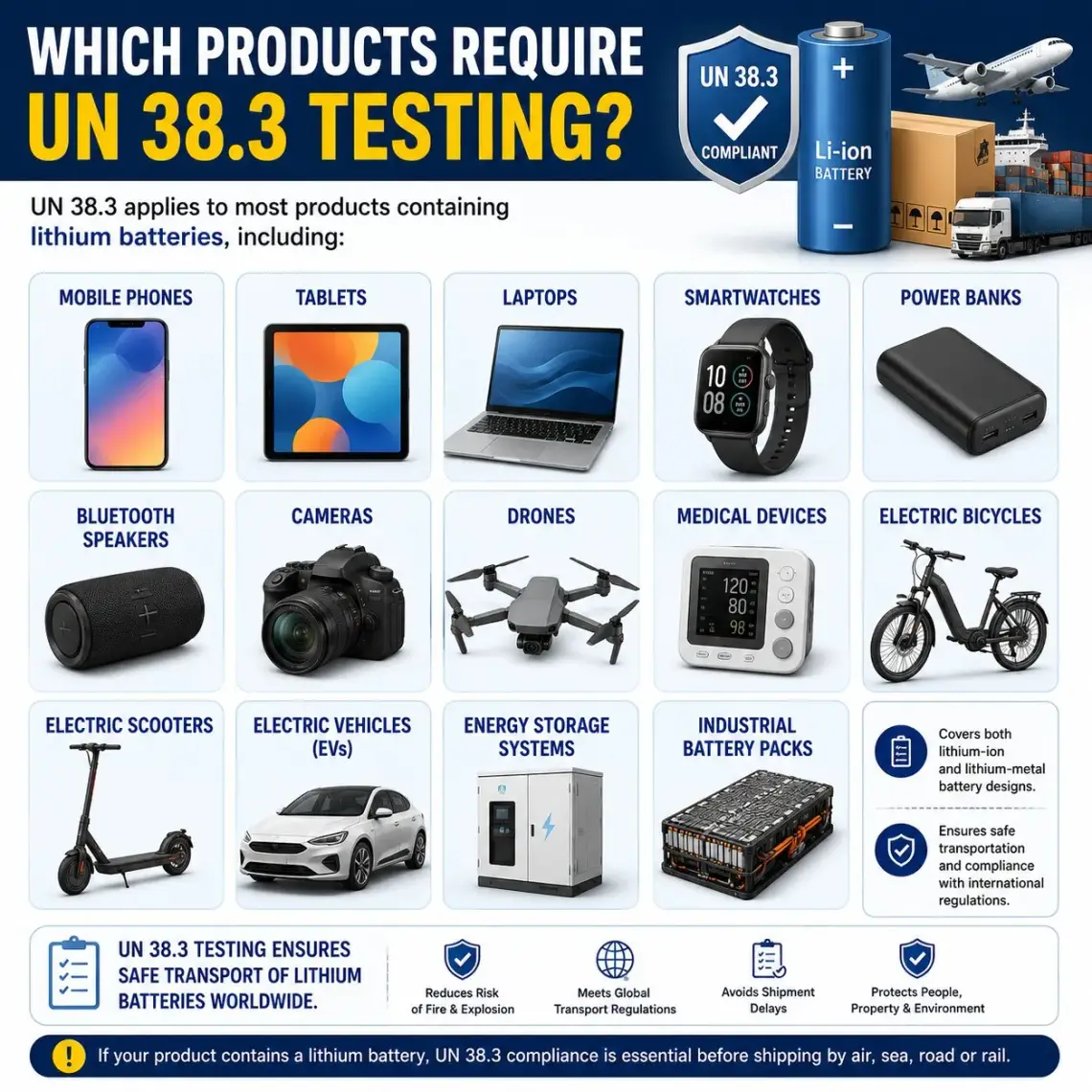
- Mobile phones
- Tablets
- Laptops
- Smartwatches
- Power banks
- Bluetooth speakers
- Cameras
- Drones
- Medical devices
- Electric bicycles
- Electric scooters
- Electric vehicles (EVs)
- Energy storage systems
- Industrial battery packs
Both lithium-ion and lithium-metal battery designs fall within the scope of these transport requirements.
Who Needs UN 38.3 Compliance?
UN 38.3 testing is important for:
- Battery manufacturers
- Battery pack assemblers
- Product manufacturers
- OEMs
- Importers
- Exporters
- Brand owners
- E-commerce sellers
- Logistics companies
- Freight forwarders
If your product contains lithium batteries and will be transported internationally, UN 38.3 compliance is often expected before shipment.
UN 38.3 Lithium Battery Transport Testing Explained
The phrase UN 38.3 lithium battery transport testing refers to a sequence of environmental, electrical, and mechanical tests designed to simulate transportation conditions.
The battery is evaluated to determine whether it remains safe throughout the shipping process.
The complete testing sequence consists of eight tests.
T1 – Altitude Simulation
This test simulates low atmospheric pressure experienced during air transportation.
It checks whether the battery remains stable without leaking, rupturing, or catching fire.
T2 – Thermal Test
The battery is repeatedly exposed to high and low temperatures.
This confirms that rapid temperature changes during shipping do not affect battery safety.
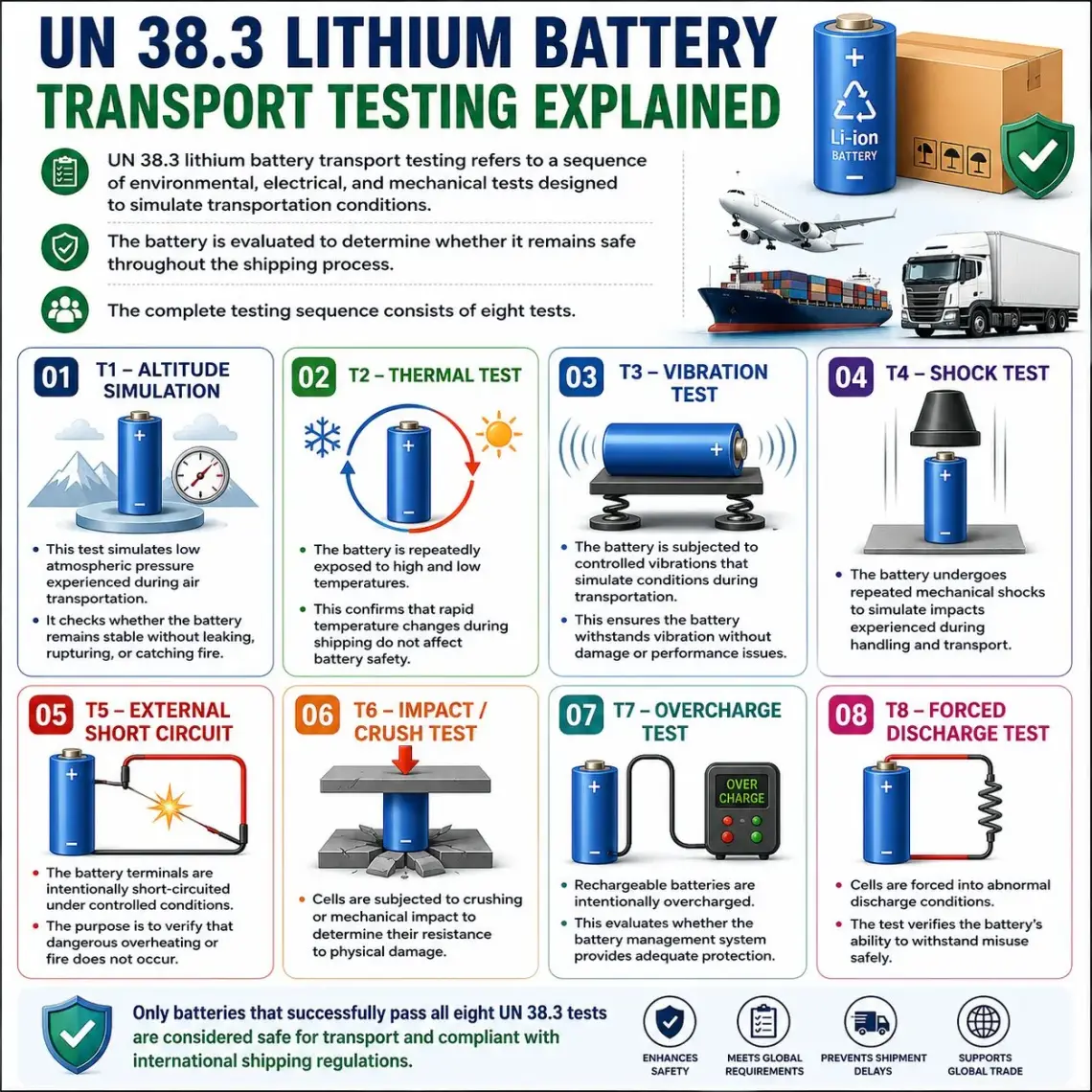
T4 – Shock Test
The battery undergoes repeated mechanical shocks to simulate impacts experienced during handling and transport.
T5 – External Short Circuit
The battery terminals are intentionally short-circuited under controlled conditions.
The purpose is to verify that dangerous overheating or fire does not occur.
T6 – Impact / Crush Test
Cells are subjected to crushing or mechanical impact to determine their resistance to physical damage.
T7 – Overcharge Test
Rechargeable batteries are intentionally overcharged.
This evaluates whether the battery management system provides adequate protection.
T8 – Forced Discharge Test
Cells are forced into abnormal discharge conditions.
The test verifies the battery's ability to withstand misuse safely.
UN 38.3 Lithium Battery Test Summary Requirement
One of the most searched topics today is the UN 38.3 lithium battery test summary requirement.
After successful testing, manufacturers and subsequent distributors are generally required to make a UN 38.3 Test Summary available for applicable lithium battery products. Rather than including a paper copy with every shipment, the summary may be made available electronically, such as through a website or QR code linked to the product, packaging, or transport documentation.
A typical Test Summary includes information such as:
- Manufacturer details
- Cell or battery model
- Test laboratory information
- Test report reference
- Confirmation that all required tests were passed
- Applicable standards
- Product identification
Many airlines, freight forwarders, customs authorities, and distributors request this document before accepting shipments.
Documents Required for UN 38.3 Testing
Although documentation may vary depending on the product, common requirements include:
- Battery specification
- Cell specification
- Product datasheet
- Battery chemistry details
- Bill of Materials (BOM)
- Product photographs
- Technical drawings
- User manual
- Battery configuration details
- Manufacturer information
Providing complete documentation usually helps speed up the testing process.
UN Numbers Commonly Used for Lithium Batteries
Depending on the shipment configuration, batteries may be classified under different UN numbers, including:
| UN Number | Description |
|---|---|
| UN3480 | Lithium-ion batteries |
| UN3481 | Lithium-ion batteries packed with or contained in equipment |
| UN3090 | Lithium metal batteries |
| UN3091 | Lithium metal batteries packed with or contained in equipment |
The applicable UN number depends on how the batteries are packaged and transported.
Latest UN 38.3 Compliance Updates (2026)
Transport regulations continue to evolve. Businesses shipping lithium batteries should pay attention to current guidance.
Important updates include:
Greater emphasis on digital Test Summaries
Manufacturers increasingly provide Test Summaries through websites or QR codes, making documentation easier to access during inspections.
State of Charge (SoC) requirements
Air transport rules continue to include strict state-of-charge requirements for certain lithium-ion battery shipments, with expanded provisions applying to additional shipment configurations in 2026.
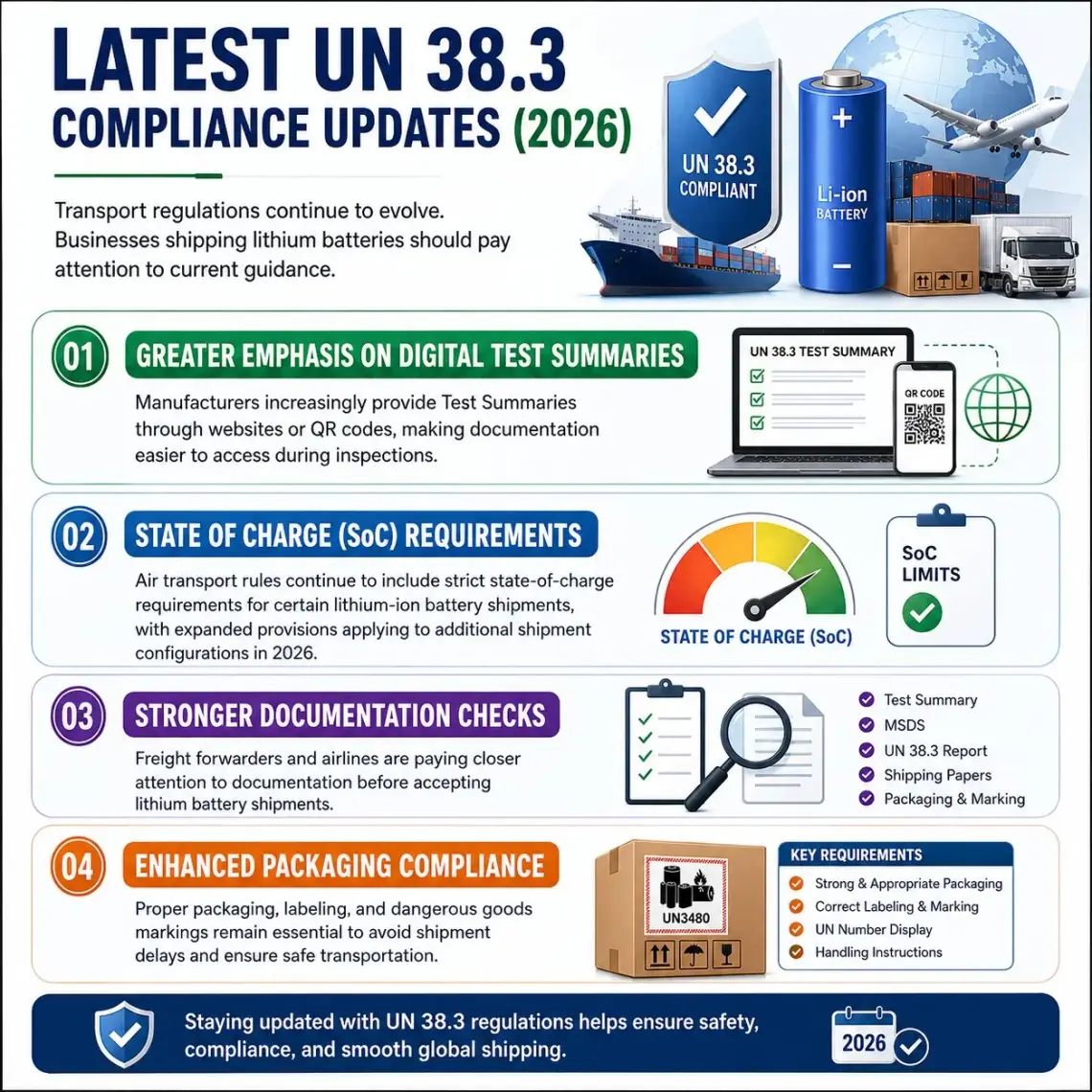
Stronger documentation checks
Freight forwarders and airlines are paying closer attention to documentation before accepting lithium battery shipments.
Enhanced packaging compliance
Proper packaging, labeling, and dangerous goods markings remain essential to avoid shipment delays.
Common Reasons for UN 38.3 Test Failure
Some batteries fail because of:
- Poor battery design
- Weak insulation
- Internal short circuits
- Improper Battery Management System (BMS)
- Mechanical damage
- Excessive temperature rise
- Cell leakage
- Manufacturing defects
Conducting product validation before formal testing can help reduce the likelihood of failure.
Difference Between UN 38.3 and IEC 62133
| UN 38.3 | IEC 62133 |
|---|---|
| Transport safety testing | Product safety standard |
| Required for shipping | Often required for market access |
| Focuses on transport conditions | Focuses on electrical and operational safety |
| Mandatory before commercial transport | Required in many certification schemes |
Many products require compliance with both standards depending on their intended market.
Benefits of UN 38.3 Testing
Choosing UN 38.3 testing offers several advantages:
- Supports international shipping
- Helps prevent transportation accidents
- Improves regulatory compliance
- Reduces shipment delays
- Enhances product credibility
- Simplifies customs clearance
- Increases customer trust
How Long Does UN 38.3 Testing Take?
Testing duration depends on:
- Product type
- Battery size
- Battery chemistry
- Number of models
- Availability of samples
- Laboratory workload
Manufacturers should plan testing early to avoid delays in product launches or export schedules.
Tips Before Applying for UN 38.3 Testing
Before submitting your batteries:
- Verify battery specifications.
- Prepare complete technical documentation.
- Ensure the battery design is finalized.
- Use production-representative samples.
- Confirm labeling and product identification are accurate.
- Work with an experienced testing laboratory.
Early preparation can help reduce testing delays and unnecessary costs.
Conclusion UN 38.3 Testing is one of the most important compliance requirements for lithium battery transportation. Whether you manufacture batteries, import battery-powered products, or export electronics globally, completing the required testing and maintaining the appropriate documentation can help ensure smoother shipments and compliance with international transport regulations. As lithium battery regulations continue to evolve, staying updated with transport requirements, documentation practices, and test summary obligations is essential. Investing in proper UN 38.3 lithium battery transport testing and maintaining compliance with the UN 38.3 lithium battery test summary requirement can help businesses avoid costly shipping disruptions while demonstrating a commitment to product safety and regulatory compliance.Frequently asked questions
What is included in UN 38.3 lithium battery transport testing?
UN 38.3 lithium battery transport testing includes eight safety evaluations such as altitude simulation, thermal cycling, vibration, shock, external short circuit, impact or crush, overcharge, and forced discharge to verify safe transportation under normal shipping conditions.
Is UN 38.3 different from IEC 62133?
Yes. UN 38.3 focuses on transportation safety for lithium batteries, while IEC 62133 evaluates the electrical and operational safety of portable rechargeable batteries. Depending on the target market, manufacturers may need to comply with both requirements.
What happens if a lithium battery fails UN 38.3 Testing?
If a battery fails any required test, it cannot be considered compliant for transport until the design issues are resolved and the battery successfully passes the applicable testing sequence. Manufacturers often redesign and retest affected battery models.
Can UN 38.3 Testing help with international exports?
Yes. UN 38.3 Testing supports international transportation by demonstrating compliance with global shipping requirements. It helps manufacturers and exporters reduce customs issues, shipment delays, and transportation risks while improving confidence among logistics providers and customers.
What is the UN 38.3 lithium battery test summary requirement?
The UN 38.3 lithium battery test summary requirement requires manufacturers and distributors to make a test summary available after successful testing. The summary confirms that the battery has passed all required transport safety tests and supports shipment compliance.