
Global Compliance
2026 Cable Crackdown: Why Selling Uncertified Cables Could Cost You Your Factory
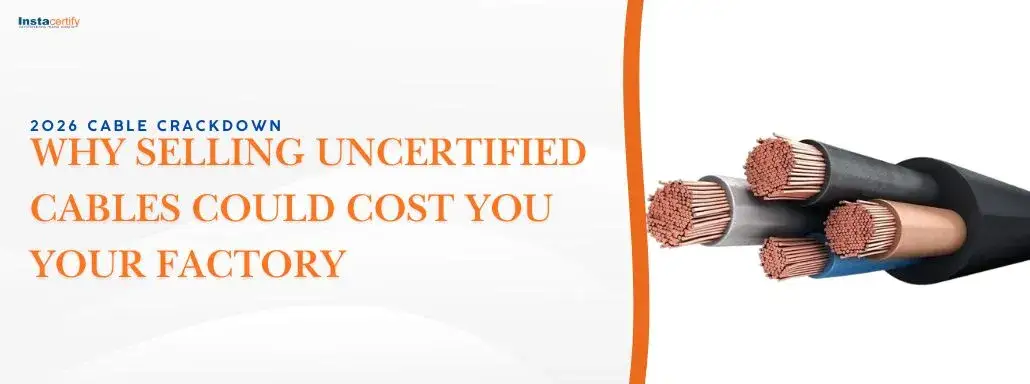
Imagine this: you’ve just built a state-of-the-art manufacturing facility, or perhaps a beautiful new home. The architecture is flawless, the interiors are breathtaking, but behind those pristine walls lies a hidden network of veins powering the entire structure. We’re talking about electrical cables.
Now, what happens if those veins are compromised?
In recent months, the Indian government and the Bureau of Indian Standards (BIS) have sounded a massive alarm regarding the rampant circulation of substandard, uncertified electrical cables. With electrical short circuits being one of the leading causes of devastating fires in commercial and residential buildings across the country, the regulatory bodies are taking a zero-tolerance approach.
latest news is clear and uncompromising: Manufacturing, importing, or selling electrical cables without a valid ISI Mark is not just risky; it is entirely illegal. The Ministry of Commer ce and Industry has strictly enforced Quality Control Orders (QCOs) placing various categories of cables under the mandatory BIS certification scheme.
If you are a cable manufacturer, importer, or distributor, the landscape has officially shifted. Compliance is no longer a “good-to-have” marketing tool—it is the baseline for your business survival.
Let’s dive deep into everything you need to know about the mandatory ISI Mark for cables, why the regulations have tightened, and how you can seamlessly navigate the certification process.
What Exactly is the ISI Mark for Cables?
The ISI (Indian Standards Institution) mark is a certification mark for industrial products in India, operated by the Bureau of Indian Standards (BIS). When you see the ISI logo stamped on a coil of wire or a heavy-duty cable, it serves as a non-negotiable guarantee. It tells the consumer, the contractor, and the government that the product has undergone rigorous testing and complies strictly with the relevant Indian Standards (IS).
For cables, this means the product has been tested for:
- Conductor Resistance: Ensuring the metal inside carries current efficiently without overheating.
- Tensile Strength and Elongation: Ensuring the outer insulation can withstand physical stress without tearing.
- Flammability: Ensuring the cable does not act as a catalyst in the event of a fire.
- Insulation Resistance: Preventing fatal electrical leaks and shocks.
“Latest News” Factor: Why the Sudden Regulatory Iron Fist?
You might be wondering, “Cables have always needed to be safe, so why is there so much buzz right now?”
The regulatory environment in 2026 has become intensely data-driven and consumer-focused. Market surveillance by BIS authorities has revealed a terrifying influx of cheap, low-grade imported and locally manufactured cables that use inferior copper and highly flammable PVC insulation.
To combat this, the government has unleashed routine market raids and strict port inspections. Importers are finding their shipments seized at customs if they lack the BIS certification. Furthermore, major e-commerce platforms and modern retail chains have updated their vendor policies—if your cables don’t have an ISI mark, your listings will be taken down overnight.
The message is loud and clear: Substandard cables are a matter of national safety, and the government is aggressively weeding out non-compliant players to protect lives and infrastructure.
Which Cables Fall Under the Mandatory BIS Radar?
The BIS has categorized cables into various specific standards based on their application, voltage, and material. If your product falls into any of the following major categories, mandatory ISI certification is required:
- PVC Insulated Cables (IS 694): These are your everyday heroes. Used extensively in domestic wiring, lighting circuits, and basic industrial applications. Due to their high volume in the market, they are heavily heavily scrutinized by authorities.
- XLPE Insulated Power Cables (IS 7098 – Part 1 & Part 2): Cross-linked polyethylene (XLPE) cables are designed to handle higher voltages and higher temperatures. They are the backbone of utility networks, underground power transmission, and heavy industries.
- Elastomer Insulated Cables (IS 9968): These are built for extreme flexibility and rugged environments, often used in mining, heavy machinery, and marine applications.
- PVC Insulated Heavy Duty Cables (IS 1554): Typically used for power supply in underground installations and power stations, these cables are designed to withstand significant mechanical stress.
(Note: The exact IS standard applicable depends on the specific voltage grade, conductor material, and insulation type of your product. Identifying the correct standard is the critical first step in compliance).
Shocking Cost of Non-Compliance
Let’s humanize the legal jargon for a moment. What actually happens if you decide to skip the ISI certification to save a few bucks on compliance costs?
- Crippling Financial Penalties: Under the BIS Act, selling products covered under mandatory QCOs without an ISI mark can attract massive fines, sometimes running into lakhs of rupees or multiplying based on the value of the seized goods.
- Imprisonment: Yes, the authorities can and will pursue criminal charges, leading to potential jail time for the directors or business owners.
- Seizure of Inventory: Your factory can be sealed, and all non-compliant inventory can be confiscated and destroyed.
- Brand Assassination: In today’s hyper-connected world, news of a company selling unsafe, uncertified electrical products spreads like wildfire. Once contractors and builders lose trust in your brand, recovering that reputation is nearly impossible.
Business Upside: Why ISI Mark is Your Biggest Growth Hack
It’s easy to look at BIS ISI Markcertification as a regulatory headache. But smart business owners view it as a powerful competitive advantage.
- Premium Pricing Power: An ISI mark instantly elevates your product from a “commodity” to a “trusted brand.” Consumers are willing to pay a premium for guaranteed safety.
- Access to Government Tenders: Want to supply cables to the Railways, Defense, or massive state infrastructure projects? An ISI mark is the mandatory ticket to enter the bidding room.
- Retail and B2B Dominance: Large developers, architects, and corporate builders have strict internal policies to only procure BIS-certified materials to limit their own liability.
