Indian Compliance
WPC ETA Documents Required in India: What You Actually Need Before Filing
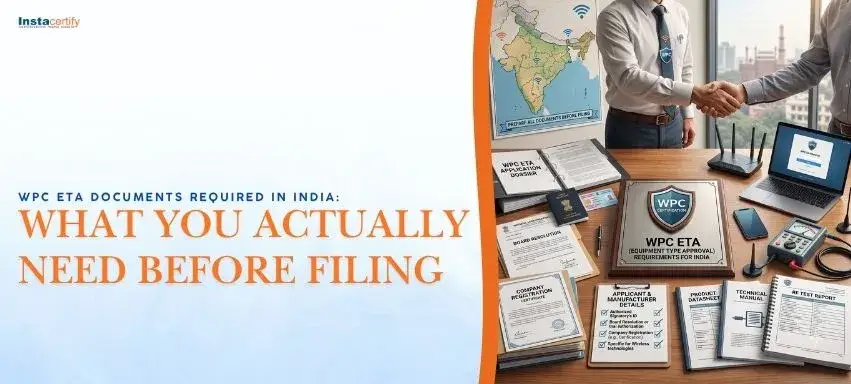
The official WPC ETA document list is short. The practical work is not.
For an ETA application, the Department of Telecommunications (DoT) currently lists three main documents: an RF Test Report, manufacturer authorization where applicable for an Indian representative, and technical literature. The current DoT service page also states a ₹10,000 ETA fee and identifies Saral Sanchar as the application route.
What usually causes trouble is not the number of documents. It is whether the documents actually match the product being filed.
Real Question is Not “What Documents are Required?”
A supplier may send you a PDF and say, “This is the WPC report.” That does not automatically mean the report is ready for an ETA application.
Before filing, someone needs to check the exact product model, manufacturer, RF module, operating frequencies, test standard, test laboratory and hardware configuration. If these do not line up, the application can become difficult to defend or may need correction.
That is why a good WPC ETA process normally starts with the product file, not with the portal.
Three Documents Officially Listed by DoT
Document | What it means | What to check |
RF Test Report | Radio-frequency test evidence for the product/module. | Model, RF module, frequencies, standards, lab and accreditation. |
Manufacturer Authorization | Authorization from the manufacturer where an Indian representative is involved. | Correct manufacturer name, Indian applicant/representative and product/model. |
Technical Literature | Technical information describing the equipment. | Model, wireless functions, bands, module details and specifications. |
RF Test Report: this is where most practical checking happens
The RF report is normally the first document we would ask a client to share. DoT's FAQ states that an RF test report issued by an Accredited Laboratory is required. It also says that where an imported product contains multiple RF modules, the report(s) for all modules are to be uploaded without alteration.
Do not check only the first page. Open the report and compare it with the actual product.
- Exact product/model number
- Manufacturer name
- RF module or chipset identification, where stated
- Operating frequency and supported wireless functions
- Applicable test standard
- Laboratory name and accreditation details
- Hardware/version information where relevant
- Complete report, including the pages and annexures needed to understand the results
A report can look genuine and still be the wrong report for the model you are importing. That is one of the most common practical issues.
Can a Chinese or overseas laboratory report be used?
An overseas report is not automatically unusable. The important point is whether the laboratory is appropriately accredited and whether its scope covers the relevant testing.
For example, CNAS is an ILAC MRA signatory, and ILAC's mutual-recognition framework covers accredited testing laboratories operating to ISO/IEC 17025. In practice, however, “the lab is ISO 17025” is not enough by itself. The accreditation and scope should be checked against the actual testing reported.
So if your Chinese supplier sends a CNAS laboratory report, do not reject it simply because the laboratory is in China. Check the accreditation, scope, report details and product match first.
Test Standard Has to Make Sense for the Product
This is another area where a filing can go wrong. You cannot choose a standard just because it appears on another company's WPC file.
For example, EN 300 328 is commonly associated with 2.4 GHz wideband transmission systems such as Bluetooth and WLAN/RLAN equipment. Other radio products may fall under different ETSI standards depending on their frequency, technology and use.
The correct approach is to identify what the product actually transmits, then confirm the relevant testing route.
- Wi-Fi + Bluetooth product → identify the relevant 2.4 GHz/other supported bands and technologies.
- Short-range device → check the frequency range, power and technology before selecting the standard.
- Multiple wireless modules → check whether separate module reports are required.
If the supplier says, “Use this standard because we used it last time,” that is not a technical justification.
A. What if you do not have an RF Test Report?
This is not necessarily a reason to stop the project. If your overseas supplier does not have a suitable RF test report, the product can be tested in India at an appropriately accredited laboratory. Where a suitable NABL-accredited laboratory and relevant test scope are available, Instacertify can coordinate the testing and help identify the right laboratory based on the wireless bands and test requirements.
As a practical budget indication, RF testing in India can often fall in the range of about ₹14,000–₹25,000 per band. This is an indicative range, not a fixed government fee. The actual amount depends on the laboratory, wireless technology, number of bands, required test scope and laboratory availability.
For example, a product with Wi-Fi and Bluetooth may not have the same testing cost as a simple single-band wireless product. Before sending the product to a lab, the test scope should be checked so that you do not pay for testing that does not help with the ETA application.
Instacertify can help arrange the laboratory and coordinate the testing process, including checking which bands need to be covered and what technical documents the lab needs before testing starts.
B. WPC ETA is handled model-wise — do not assume a series approval
One practical point that is often misunderstood is the idea of a single 'series' WPC ETA covering several different model numbers. The current DoT FAQ and ETA framework refer to the product level, and the WPC self-declaration format specifies the ETA fee per model.
In practical terms, do not assume that Model A automatically covers Model B simply because both products look similar or use the same RF module. Each model should be assessed on its own. If several model numbers are proposed for one filing, first check whether the products are genuinely the same approved configuration and whether the current WPC process permits the proposed treatment.
The safest working rule for an importer is simple: treat each model number as a separate compliance item unless the applicable WPC process clearly confirms otherwise.
Manufacturer Authorization: Do Not Treat it as a Formality
The authorization should connect the manufacturer with the Indian applicant/representative and the product being filed.
Check that the legal manufacturer name is consistent across the authorization, RF report and technical literature. If the report says one company, the authorization says another, and the product label shows a third name, stop and clarify the relationship before filing.
For overseas manufacturers, this document becomes especially important when the Indian company is handling the application.
Technical Literature: More Than a Marketing Brochure
DoT simply calls for “Technical Literature.” In practice, a useful technical file should allow the reviewer to understand what the equipment is and what wireless functions it has.
- Product model and manufacturer
- Wireless technologies
- Frequency bands
- RF module/chipset information, if available
- Power or other relevant RF parameters
- Product photographs or identification information where useful
- Basic technical specifications
A glossy product catalogue can be useful, but it may not contain enough technical information to answer questions about the radio section.
Company documents: Keep Them Ready Even When They are Not the Three Headline ETA Documents
The official ETA page lists three core documents. That does not mean you should wait until the filing screen to collect basic company information.
- PAN and company/entity details
- GST details where applicable
- Certificate of Incorporation or equivalent entity proof
- Authorized person's details
- Manufacturer and importer/representative details
The exact supporting information required can depend on the application structure and applicant situation. The sensible approach is to prepare the company file before the technical file is finalized.
What about a Digital Signature Certificate (DSC)?
Do not describe DSC as a universal ETA document simply because it is used on government portals. DSC requirements depend on the particular application workflow. The important practical point is to make sure the authorized person can complete the required portal authentication/signing steps before the filing is ready.
For the current ETA service, DoT identifies Saral Sanchar as the application route. The broader portal landscape has also changed with the Telecommunications Act, 2023, so it is better to check the live DoT workflow rather than rely on an old checklist copied from a previous application.
If the product has Wi-Fi and Bluetooth, what should you ask the supplier for?
Suppose you are importing a smart device with Wi-Fi and Bluetooth. Before filing, ask the supplier for:
- Complete RF test report(s)
- Exact model number covered by the report
- Wireless module/chipset details
- Frequency and technology details
- Laboratory accreditation information
- Manufacturer authorization
- Technical datasheet/manual
- Product photographs and label details if available
Then compare everything. If the report is for Model A but you are importing Model B, do not assume the difference is harmless. If the same product has changed its RF module or hardware version, check whether the existing report still represents the product.
Multiple RF Modules: One Product Does Not Always Mean One Report
This matters for products containing several wireless functions. DoT's ETA FAQ specifically says that if an imported product contains multiple RF modules, the report(s) of all RF modules are to be uploaded without alteration.
For example, a product could contain Wi-Fi, Bluetooth and another radio interface. Before filing, map the wireless modules instead of assuming one report covers everything.
ETA is Not the Same thing as every WPC requirement
Another common mistake is treating ETA as a universal WPC approval for every wireless product.
The current DoT ETA page describes ETA for eligible equipment operating in de-licensed bands and excludes certain categories from the self-declaration route, including radar, jamming devices, drones and satellite equipment. Separate WPC services, including import licensing, exist for other situations.
So the first question should be: “Is ETA actually the correct route for this product?”
What happens when documents do not match?
This is where practical experience matters.
- Wrong model number → obtain clarification before filing.
- Different manufacturer names → establish the legal relationship.
- Old RF module report → verify the current hardware.
- Lab accreditation unclear → verify the accreditation and scope.
- Report missing annexures → obtain the complete report.
- Product has additional wireless modules → check all RF modules.
- Product falls outside the self-declaration ETA route → assess the correct WPC process instead.
It is usually cheaper to solve these questions before submission than after a filing has been made.
A Simple document map to use before filing
Check | Question | Status |
Product identity | Does the exact model match across all documents? | ☐ |
RF report | Is the report complete and for the product/module being filed? | ☐ |
Lab | Is the laboratory accreditation and relevant scope clear? | ☐ |
Frequency | Do the reported bands match the actual product? | ☐ |
Standard | Does the test standard fit the wireless technology? | ☐ |
Manufacturer | Do the legal names match across documents? | ☐ |
Authorization | Is the manufacturer authorization correctly issued? | ☐ |
Technical literature | Does it clearly describe the wireless functions? | ☐ |
Multiple modules | Have all RF modules been identified and supported? | ☐ |
Route | Is ETA the correct WPC route for the product? | ☐ |
Better Way to Handle WPC ETA
A practical sequence is:
- Identify the exact product and wireless functions.
- Collect the RF report(s) and technical literature.
- Check the model, manufacturer, module and frequency details.
- Verify the laboratory and relevant accreditation information.
- Confirm the applicable testing standard.
- Check the manufacturer authorization.
- Confirm that the product fits the ETA/self-declaration route.
- Prepare the applicant/company information.
- Then complete the government filing and payment.
In short: check first, file second.
WPC ETA Approval by Instacertify
If you are importing or selling a wireless product in India and are unsure whether your documents are actually usable, Instacertify can review the product file before you proceed.
Not sure what is mandatory and what is not?
This is often the most useful conversation to have before spending money on testing or filing.
Instacertify can schedule a one-hour expert call for ₹499 to review your product, documents and likely compliance route, and explain what is mandatory, what is not, and what should be checked before you move ahead.
If you already have an RF report from your supplier, send it for review before assuming it is suitable for the Indian ETA application.
Frequently asked questions
What are the main documents required for WPC ETA?
DoT currently lists three: RF Test Report, Authorization from Manufacturer for an Indian Representative, and Technical Literature.
Is an RF test report mandatory?
Yes. DoT's ETA FAQ states that an RF test report from an Accredited Laboratory is required.
Can a report from a laboratory outside India be used?
An overseas report may be usable if the laboratory and report meet the applicable requirements. The laboratory accreditation and testing scope should be checked rather than judging the report only by the country where the lab is located.
Is WPC ETA required for every wireless product?
Not every wireless product follows the same route. Eligible products operating in permitted de-licensed bands can use the ETA self-declaration route, while certain categories and other wireless situations follow different WPC processes.
How much is the ETA fee?
The current DoT ETA service page and FAQ state a fee of ₹10,000. The FAQ says this applies for each product having one or more inbuilt RF modules.
What is the biggest mistake importers make?
Filing from a document pack without checking whether the RF report, model, manufacturer, module, frequency and technical literature all describe the same product.