Indian Compliance
WPC ETA for IoT Devices in India: Does Your Product Need It?
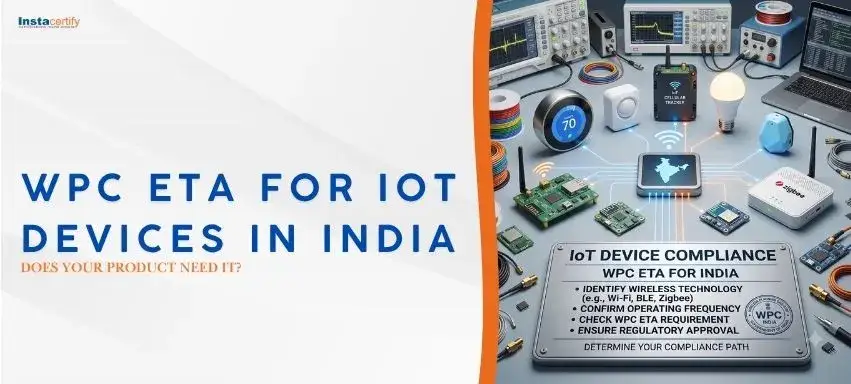
“IoT device” is not one wireless category.
An IoT product may use WiFi, Bluetooth, Zigbee, another short-range radio, cellular connectivity or more than one radio in the same product.
That is why an IoT WPC article should not simply say that every IoT device needs WPC ETA. The wireless configuration has to be understood first.
First Question: What Kind of IoT Device Are You Importing?
Start by identifying what the product actually communicates with.
Is it a WiFi sensor? A Bluetooth device? A Zigbee gateway? A cellular tracker? A smart appliance with several radios?
The answer determines which technical and regulatory questions need to be checked.
WiFi IoT Device? Here's What to Check
Identify the WiFi bands, module, chipset, model and RF report.
Check that the report actually covers the configuration being imported.
If the product also contains Bluetooth or another radio, include those interfaces in the document review.
Bluetooth IoT Device? Don't Skip the RF Report
For Bluetooth-enabled IoT equipment, check the exact model, module, operating frequency, test standard, laboratory and accreditation.
Do not assume that because the module is common, every finished product using it is automatically covered.
What If the IoT Product Uses Zigbee or Another Radio?
For Zigbee and other short-range technologies, the applicable standard and testing route should be identified from the actual radio parameters.
The term “IoT” by itself is not enough to determine the compliance route.
Cellular IoT Is a Different Compliance Question
A cellular IoT product can involve a different regulatory situation from a WiFi or Bluetooth device.
Do not assume that WPC ETA alone covers every requirement associated with cellular connectivity. The complete product should be screened for other applicable telecom or equipment requirements.
Your Supplier Has No RF Report? Testing in India Is Possible
If the supplier does not have a suitable RF report, the product can be tested in India at a suitable NABL-accredited laboratory where the relevant test scope is available.
A practical indicative range is ₹14,000–₹25,000 per band, depending on the laboratory, band, test scope and availability.
This is not a government fee. It is an indicative laboratory testing range.
Instacertify can help identify and arrange the laboratory.
How Much Does RF Testing Cost?
The actual cost depends on the radio technology, number of bands, required test scope, laboratory and availability.
For planning purposes, ₹14,000–₹25,000 per band can be used as an indicative range, but the laboratory should confirm the actual quotation for the product.
What If Your IoT Device Has Multiple RF Modules?
This is common in IoT equipment.
A device can contain WiFi, Bluetooth and another wireless module. Map every RF interface before filing.
DoT's ETA FAQ specifically addresses products containing multiple RF modules and requires the relevant report or reports to be uploaded without alteration.
Can a Module Test Report Be Used for the Finished Product?
A module manufacturer's test report can be useful, especially when the same module is integrated into several products.
But it should not automatically be treated as a universal approval for every finished device.
Check the module, integration, antenna arrangement, hardware configuration and the requirements applicable to the finished product.
Does One WPC ETA Cover an Entire IoT Product Series?
Do not assume that it does.
For compliance planning, treat each finished-product model as a separate compliance item unless the applicable WPC process specifically allows another treatment.
Several IoT devices may share the same module while still having different models and configurations.
What Documents Should You Ask the Manufacturer For?
Ask for the exact model number, manufacturer details, RF report or reports, module information, datasheet, technical specifications, user manual where available, product photographs and manufacturer authorization.
Then compare the documents with the actual product configuration.
Common IoT WPC Mistakes
Common mistakes include treating every IoT device as the same regulatory category, ignoring one of the RF modules, using a module report without checking integration, selecting a standard without checking the frequency, assuming one ETA covers a product family and filing before confirming the correct route.
How to Check Your Product Before Filing
Map every radio, identify bands and modules, collect RF reports, verify laboratory accreditation and scope, match model and manufacturer, confirm standards, prepare authorization and technical literature, check for other applicable approvals and then decide the filing route.
Not Sure Which Approval Your IoT Product Needs?
IoT products often need more technical screening than a simple Bluetooth accessory.
Instacertify can review the wireless configuration, identify the testing needed, coordinate Indian laboratory testing where required, prepare the documentation and manage the WPC ETA process.
If you want to understand what is mandatory and what is not before proceeding, a one-hour expert call is available for ₹499.