Chemicals
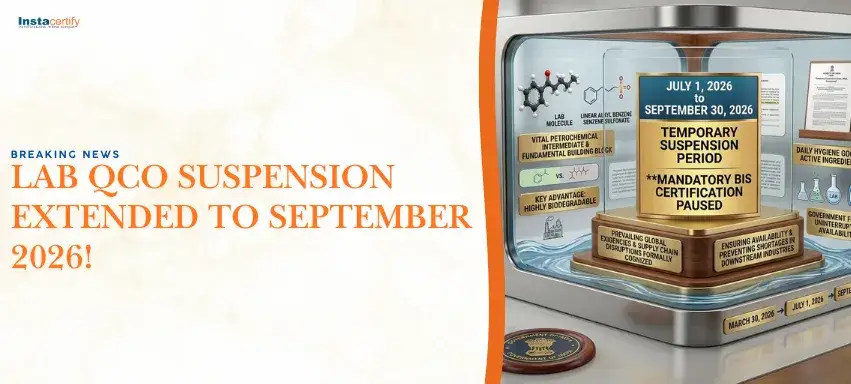
Breaking News: LAB QCO Suspension Extended to September 2026!
The chemical and detergent manufacturing sectors can breathe a sigh of relief—for a little while longer. The Indian government has just announced a crucial update regarding the mandatory compliance standards for a vital chemical intermediate.
According to the official gazette notification, detailed in the document Temporary_Suspension, the implementation timeline has shifted significantly. If you are involved in manufacturing, importing, or utilizing this chemical, staying on top of these regulatory shifts is essential for your business operations. Here is a comprehensive, user-friendly breakdown of the latest official update, what it means for your supply chain, and how you should prepare for the future.
Latest Official Update
On June 25, 2026, the Ministry of Chemicals and Fertilizers (Department of Chemicals and Petrochemicals) issued a significant notification in the Gazette of India. This new order, officially designated as S.O. 3456(E), directly amends the existing Linear Alkyl Benzene (Quality Control) Order, 2022.
As seen in Temporary_Suspension_Linear_Alkyl_Benzene.pdf, the industry was previously operating under a temporary suspension of these quality control rules, which had been last amended on March 30, 2026. However, this latest announcement introduces a crucial substitution in the regulatory timeline. According to the June 25 notification, the suspension period has been officially extended to run from July 1, 2026, to September 30, 2026.
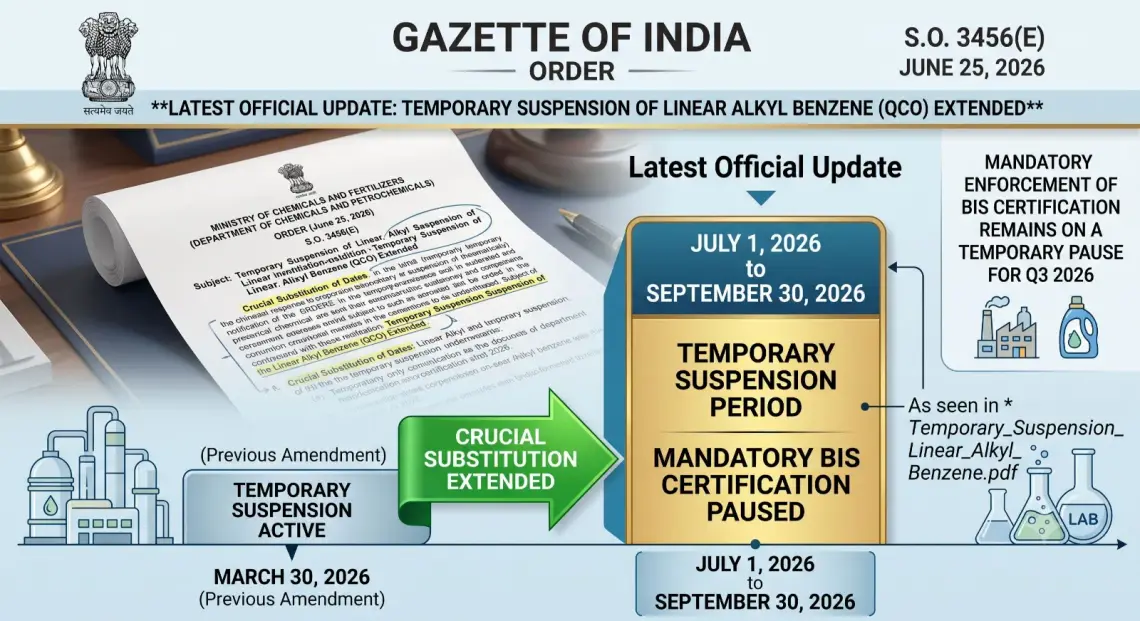
This means that for the third quarter of 2026, the mandatory enforcement of the Bureau of Indian Standards (BIS) certification for this specific chemical remains on a temporary pause.
Why Did the Government Extend the Suspension?
Regulatory bodies do not suspend quality control orders lightly. The original Linear Alkyl Benzene (Quality Control) Order was established back on April 5, 2022, to ensure strict quality and safety standards across the market. So, why the extended pause?
The official Gazette notification text in Temporary_Suspension_Linear_Alkyl_Benzene.pdf provides clear reasoning for this decision. The Central Government, operating in consultation with the Bureau of Indian Standards, cited prevailing global exigencies as the primary driver for this temporary relaxation. Specifically, the authorities have taken formal cognizance of ongoing supply chain disruptions.
The primary goal of this suspension is highly practical: to ensure the continued availability of Linear Alkyl Benzene within the domestic market. By temporarily lifting the mandatory compliance burden, the government is actively working to prevent critical shortages that could ripple through downstream industries, keeping production lines moving despite global logistical challenges.
Understanding the Regulatory Framework
For those managing compliance, it is important to understand the legal backing of this move. As outlined in Temporary_Suspension_Linear_Alkyl_Benzene.pdf, the government exercised its powers under section 16, read in conjunction with sub-section (3) of section 25 of the Bureau of Indian Standards Act, 2016, to enact this temporary suspension.
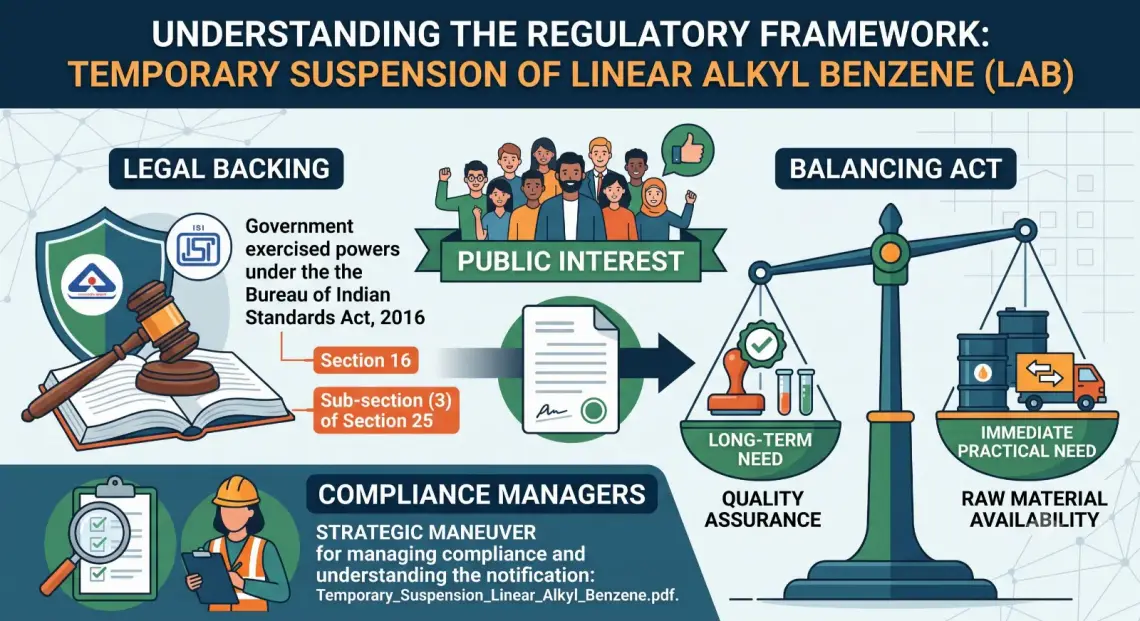
The notification emphasizes that this action is being taken strictly in the public interest. It is a strategic maneuver designed to balance the long-term need for quality assurance with the immediate, practical need for raw material availability.
What is Linear Alkyl Benzene (LAB)?
To fully grasp the importance of this regulatory update, one must understand the role this chemical plays in the broader manufacturing ecosystem. Linear Alkyl Benzene, commonly referred to as LAB, is a vital petrochemical intermediate. It is recognized primarily for its critical function in the production of surfactants.
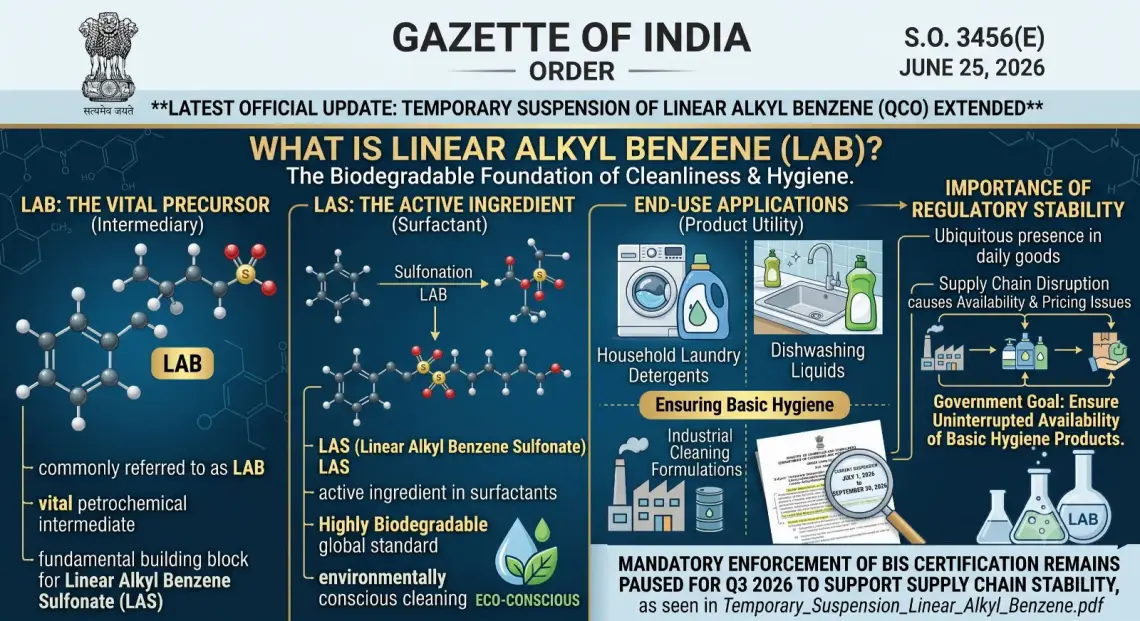
Specifically, LAB is the fundamental building block for Linear Alkyl Benzene Sulfonate (LAS). LAS is the active ingredient found in the vast majority of household laundry detergents, dishwashing liquids, and a wide array of industrial cleaning formulations. Because it is highly biodegradable compared to older, branched-chain alternatives, it has become the global standard for environmentally conscious cleaning products.
Given its ubiquitous presence in daily consumer goods, any disruption in the LAB supply chain can lead to immediate and widespread issues in the availability and pricing of basic hygiene products. This widespread utility underscores exactly why the government is so keen to ensure its uninterrupted availability.
What Does This Mean for Your Business?
If you are an importer or manufacturer, this three-month window provides vital breathing room:
For Importers: During the period from July 1, 2026, to September 30, 2026, you will not face the immediate hurdle of securing BIS certification for incoming shipments. This flexibility is critical for bridging supply gaps caused by global disruptions.
For Manufacturers: Domestic producers also benefit from a temporary easing of standard enforcement, allowing for smoother operations while the global market stabilizes.
For Downstream Industries: Companies relying on this chemical to manufacture detergents and cleaning agents can expect a more stabilized supply chain over the next few months, protecting against sudden raw material shortages.
Looking Ahead: Prepare for October
While this extension is welcome news for many, it is absolutely vital to recognize that it is a temporary measure. The wording in Temporary_Suspension_Linear_Alkyl_Benzene.pdf is clear—the operation of the order is suspended temporarily, not revoked.
Come October 1, 2026, the temporary window will close, and the stringent requirements of the 2022 Quality Control Order are expected to be reinstated. Businesses must not use this three-month grace period to ignore compliance. Instead, proactive companies will utilize this time to aggressively pursue and finalize their BIS certification processes.
Use this time wisely, secure your supply chains, and ensure that your operations are fully ready to meet Indian Standards when the regulatory pause inevitably comes to an end.