Did you Know
Licences Required for Importing Products in India – Complete Import Compliance & Certification Guide
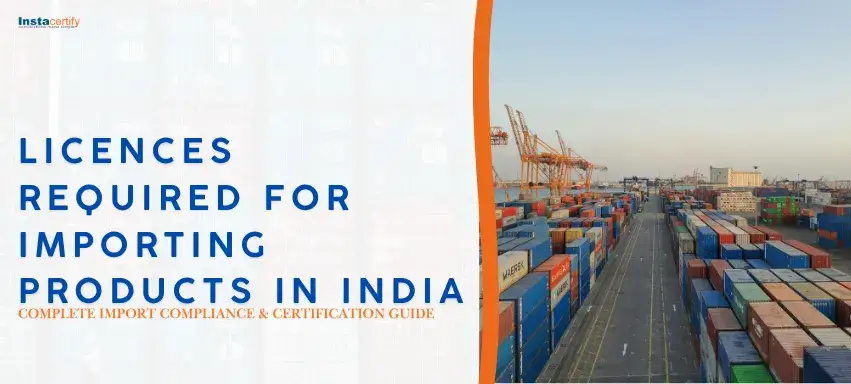
Importing products into India involves more than arranging shipping and customs clearance. Depending on the product, its classification, intended use, packaging, technology and applicable regulations, an importer may need registrations, licences, certifications, testing, labelling compliance or approvals from different authorities.
There is no single licence that makes every imported product compliant. The Import Export Code (IEC) is the standard starting point for import/export activities, except where an exemption applies. Beyond IEC, the exact compliance pathway must be checked product-by-product using the applicable ITC(HS) classification, import policy conditions and sector-specific regulations.
This guide explains the main import compliances to check before bringing products into India and provides links to detailed certification and registration services.
IEC Certificate – The Starting Point for Every Importer
The Import Export Code (IEC) is the fundamental licence for anyone wishing to import or export goods in India. Issued by the Directorate General of Foreign Trade (DGFT), it serves as a unique identification number for all international trade transactions. Without an IEC, no import or export can legally occur. Key facts:- Issued by DGFT, under the Ministry of Commerce.
- Required for both individuals and companies involved in import/export.
- Apply online with PAN, address proof, bank details, and digital signature.
- Very easy to apply with Rs. 500 Goverment fees to get one
- Issued same day as the application
What Licences or Registrations May Be Required for Imports in India?
The requirements vary according to the product. Some requirements relate to the importer and customs process, while others apply only to specific product categories.
| Requirement | When it may apply | What to check |
|---|---|---|
| Import Export Code (IEC) | Most import/export activities, subject to exemptions | Valid IEC and updated importer details |
| Customs / ICEGATE setup | For electronic customs filing and related activities | Registration and filing requirements for the importer or customs representative |
| DGFT Import Authorisation | Restricted goods or products subject to specific import policy conditions | ITC(HS) policy and applicable authorisation |
| BIS Certification / Registration | Products covered by mandatory BIS requirements or Quality Control Orders | Exact product, Indian Standard and current QCO |
| LMPC compliance | Certain pre-packaged commodities intended for the Indian market | Packaging declarations and importer requirements |
| EPR – Plastic | Where plastic-packaging EPR obligations apply | Product, packaging and importer/producer role |
| EPR – E-Waste | Electrical and electronic equipment covered by applicable rules | Product category and EPR applicability |
| EPR – Battery | Where the imported product or battery activity falls within applicable battery-waste obligations | Battery type and role under the rules |
| WPC / ETA | Certain wireless and RF equipment | Wireless technology, frequency band and device category |
| FSSAI | Food and applicable food-related imports | Food category, licence and import-clearance requirements |
| CDSCO | Specified medical devices, cosmetics, drugs and other regulated products | Product classification and applicable CDSCO route |
| BEE | Appliances and equipment covered by the applicable Standards & Labelling programme | Exact product/model and current programme status |
| TEC / telecom requirements | Certain notified telecom equipment | Equipment category and applicable technical requirements |
| CHIMS | Certain semiconductor/chip and integrated-circuit imports covered by the applicable monitoring requirements | Exact product and HS classification |
The table is a screening guide, not a universal licence list. Applicability should be confirmed against the product and current government notification before shipment.
IEC: The Basic Importer Requirement
An Importer Exporter Code (IEC) is a 10-character code issued by DGFT and is mandatory for undertaking import/export activities unless specifically exempted. DGFT also identifies the core mandatory import documents as the transport document, commercial invoice cum packing list and Bill of Entry, with additional documents possible for goods subject to restrictions or product-specific statutory requirements.
Having an IEC does not automatically mean that a product is authorised for import or sale in India. Product-specific compliance still needs to be checked.
Check the ITC(HS) Code Before Importing
The HS/ITC(HS) classification is one of the first compliance checks an importer should perform. The classification helps identify the applicable import-policy treatment and can also point to product-specific conditions.
For restricted imports, DGFT guidance specifically requires the relevant ITC(HS) item and technical description to be considered when applying for authorisation.
However, an HS code should not be treated as the only compliance test. The exact model, composition, technical specifications, function, end use, packaging and applicable notifications may also matter.
Before ordering a product, confirm:
Product name and model → technical specifications → intended use → HS/ITC(HS) classification → import-policy status → applicable QCOs or sector regulations → required registrations, testing and labelling.
BIS Certification for Imported Products
BIS certification is not automatically required for every imported product. BIS states that its certification scheme is generally voluntary, but the Central Government makes compliance compulsory for specified products through Quality Control Orders and other notified requirements. For products covered by a mandatory QCO, the prescribed conformity requirements must be met.
Depending on the product, the relevant route may include BIS registration, BIS licence or another conformity-assessment scheme.
Importers should therefore check the exact product and current QCO, rather than assuming that all electronics, electrical products or industrial goods require the same BIS route.
Legal Metrology and LMPC for Imported Packaged Goods
Importers of pre-packaged commodities should review Legal Metrology requirements before the packaging is printed or the shipment is dispatched.
The Department of Consumer Affairs identifies mandatory package declarations that can include importer details, country of origin, generic product name, net quantity, MRP and consumer-care information. The applicable declarations depend on the product and packaging rules.
EPR Requirements for Imported Products
EPR obligations are category-specific, so importers should not assume that every imported product requires the same EPR registration.
For plastic packaging, the regulatory framework covers producers, importers and brand owners that introduce relevant plastic packaging into the market.
For e-waste, the applicable rules include certain imported electrical and electronic equipment within the definition of producer and related EPR obligations.
Battery-waste obligations similarly depend on the applicable battery category and the entity's role under the Battery Waste Management Rules.
WPC / ETA for Wireless Products
Wireless products require a separate regulatory check. The Department of Telecommunications states that Equipment Type Approval (ETA) applies to applicable wireless equipment operating in de-licensed bands or involving RF transmission, subject to the relevant regulatory route and exceptions.
For example, certain Wi-Fi, Bluetooth and other short-range wireless products may require an ETA assessment before import, sale or use in India.
Do not determine WPC applicability solely from the product's marketing name. Review the actual wireless technology, frequency and device characteristics.
FSSAI Requirements for Food Imports
Food imports follow a separate regulatory pathway. FSSAI operates the Food Import Clearance System (FICS), which is integrated with Customs processes. FSSAI guidance identifies an IEC and applicable FSSAI import licence among the prerequisites for food import clearance, along with other documents depending on the product.
The exact requirements should be checked for the specific food category before shipment.
CDSCO for Medical Devices and Cosmetics
Some imported products fall under CDSCO regulation.
For medical devices, CDSCO provides an import-licence pathway under the Medical Devices Rules, including application in MD-14 for grant of the import licence in MD-15, subject to the applicable requirements.
Imported cosmetics are also subject to registration requirements under the Cosmetics Rules, 2020. CDSCO states that cosmetics and their manufacturing premises are required to be registered before import, subject to the applicable framework.
BEE and Energy-Using Products
Some electrical appliances and equipment fall under the Bureau of Energy Efficiency's Standards & Labelling programme. The programme contains both mandatory and voluntary categories, so the exact product and current notification should be checked rather than assuming every electrical appliance requires BEE registration or star labelling.
Restricted Imports and DGFT Authorisation
Products classified as Restricted under the applicable import policy may require prior authorisation or other permissions. DGFT's ITC(HS) framework distinguishes Free, Restricted, Prohibited and other policy categories and provides specific conditions for restricted items.
This is why the import assessment should be performed before the goods are shipped, rather than waiting for the consignment to reach an Indian port.
Import Documents Checklist
Before placing an import order, use this practical checklist:
- Valid IEC available and importer details checked
- Product name, exact model and technical specifications confirmed
- Intended use and end use identified
- Correct HS/ITC(HS) classification reviewed with the customs professional
- Import-policy status checked: Free / Restricted / Prohibited / applicable conditions
- Mandatory BIS/QCO applicability checked
- LMPC and Indian packaging declarations reviewed where relevant
- Plastic, e-waste, battery or other EPR applicability assessed where relevant
- WPC/ETA checked for wireless or RF products
- FSSAI checked for food products
- CDSCO checked for medical devices, cosmetics or other regulated products
- BEE checked for applicable appliances/equipment
- Other sector-specific registrations or approvals checked
- Commercial invoice and packing list prepared
- Bill of Lading / Airway Bill or other transport document available
- Bill of Entry prepared for customs clearance
- Certificate of Origin or other supporting documents obtained where required
- Test reports, technical documents and certificates matched to the exact product/model
- Indian labelling and packaging reviewed before mass production or shipment
Why Import Compliance & Certification Matter
Following India’s import compliance rules isn’t just a legal necessity — it’s a business safeguard. Proper licences and certifications ensure smoother customs clearance, protect consumer safety, and reduce financial risk. Failure to comply can result in:- Customs detention or confiscation of goods.
- Heavy penalties under the Customs Act or BIS Act.
- Blacklisting of IEC or importer credentials.
How Instacertify Can Help
Instacertify helps importers and foreign manufacturers assess the Indian compliance pathway for their products.
The assessment can cover the relevant product category, HS/ITC(HS) classification, applicable certification or registration route, testing requirements, technical documentation, labelling considerations and regulatory submissions.
The most useful information to provide during an initial review is:
Product name + exact model + technical datasheet + product photographs + country of origin + intended use + proposed HS code, if available.
This allows the applicable compliance requirements to be assessed before the shipment is committed.
Final Reminder
Import requirements in India are product-specific and notification-driven. A certification required for one product may not apply to another product, even when both belong to the same broad industry. Requirements can also change through amendments, new Quality Control Orders and regulatory notifications.
Always verify the current requirement for the exact product before shipment, sale or commercial launch.
Frequently asked questions
Is an IEC enough to import any product into India?
No. IEC is the standard importer/exporter identification requirement, but products may also be subject to restricted-import rules, mandatory certification, sector-specific approvals, testing, labelling or environmental obligations.
Do all imported products require a BIS certificate?
No. BIS certification is generally voluntary unless a product is brought under a mandatory requirement such as a Quality Control Order or another compulsory conformity framework.
Does every importer need EPR registration?
Not automatically. EPR applicability depends on the relevant waste-management rules, product or packaging category and the importer or producer's role under those rules.
Do all wireless products require WPC ETA?
A wireless product should be assessed for WPC requirements based on its technology, frequency and regulatory category. ETA is applicable to relevant wireless equipment operating in de-licensed bands, subject to the applicable route and exceptions.
Is LMPC registration required for every imported product?
No. Legal Metrology requirements depend on the product and whether it falls within the applicable packaged-commodity framework. Imported pre-packaged consumer goods should be checked for declarations and registration requirements before sale.
Can I determine import compliance only from the HS code?
HS/ITC(HS) classification is an important starting point, particularly for import-policy checks, but it should be considered together with the product's specifications, function, intended use, packaging and applicable regulations.
Do imported food products need FSSAI compliance?
Food imports are subject to FSSAI's regulatory and import-clearance framework. The exact licence and clearance requirements depend on the food product and applicable regulations.
What are the FSSAI requirements for importing food items?
Every commercial food import requires a valid central license from the Food Safety and Standards Authority of India. Importers must register shipments through the designated clearance system to guarantee that all products strictly meet national safety and quality consumption standards.