
Global Compliance
IP Testing Explained: How Ingress Protection Ratings Are Tested Under IEC 60529
If your buyer, tender document or design spec says the product must be "IP65", the next question is usually the practical one: how is that actually tested, who does it, and what does it cost?
This guide answers exactly that. It covers what IP testing is, what the IP code means digit by digit, how each individual test is physically performed under IEC 60529, what makes a product pass or fail, and how to get it done in India.
One thing to clear up before anything else, because it causes a great deal of confusion: ingress protection is not a certification. It is a test. That distinction matters, and the next section explains why.
What Is IP Testing?
IP stands for Ingress Protection. IP testing is a laboratory evaluation that determines how well an enclosure keeps out two things:
- Solid foreign objects — fingers, tools, wires, and dust
- Water — drips, spray, jets, and immersion
The result is expressed as a two-digit code such as IP65, IP67 or IP54. The first digit describes protection against solids, the second describes protection against water.
The important word is evaluation. The lab does not decide whether your product is "good enough" in some general sense. It subjects the enclosure to a precisely defined physical test and reports whether the specified degree of protection was achieved.
What IP Testing Does Not Cover
IP ratings are frequently over-interpreted. The code says nothing about:
- Impact resistance — that is the IK rating, under IEC 62262
- Corrosion, salt spray or UV resistance
- Protection against oil, solvents or chemicals
- Protection against condensation forming inside the enclosure
- Long-term durability of seals and gaskets
An IP67 enclosure that survives immersion on day one may leak after two years of gasket compression set. IP testing is a snapshot of the enclosure's sealing performance under defined conditions — not a lifetime guarantee.
Is Ingress Protection a Certification? No — and Here's Why That Matters
This is the single most common misunderstanding in the field, and it costs exporters time and money.
There is no such thing as an IP certificate issued by a government or regulatory body. No authority in India, the EU or anywhere else "certifies" IP ratings. There is no IP licence, no IP registration number and no IP approval scheme.
What actually exists is this:
- IEC 60529 — the international standard that defines the IP code and the test methods
- A test report — issued by a laboratory that performed those tests on your sample
- A manufacturer's declaration — you, the manufacturer, declare the IP rating of your product on the basis of that test report
So when a tender or a customer asks for "IP65 certification", what they will accept — and what they actually need — is a test report from a competent laboratory showing the product was tested to IEC 60529 and achieved IP65.
Why the Distinction is Practically Important
- You do not need to wait for an approval body. There is no queue, no application, no scrutiny period. Book the test, send the sample, get the report.
- The lab's accreditation is what gives the report weight. A report from an ISO/IEC 17025 accredited laboratory is accepted globally. A report from an unaccredited workshop generally is not.
- You can test to the rating you need. You are not applying for a fixed grade — you specify the target rating, and the lab tests against it.
- Cost and time are modest. Because it is a test rather than a certification scheme, IP testing is one of the cheapest and fastest compliance activities you will encounter.
In short: any ISO/IEC 17025 accredited laboratory can perform IP testing as per IEC 60529 and issue a valid test report. That report is what your buyer, tender authority or notified body wants to see.
Understanding the IP Code: What IP65, IP67 and IP54 Actually Mean
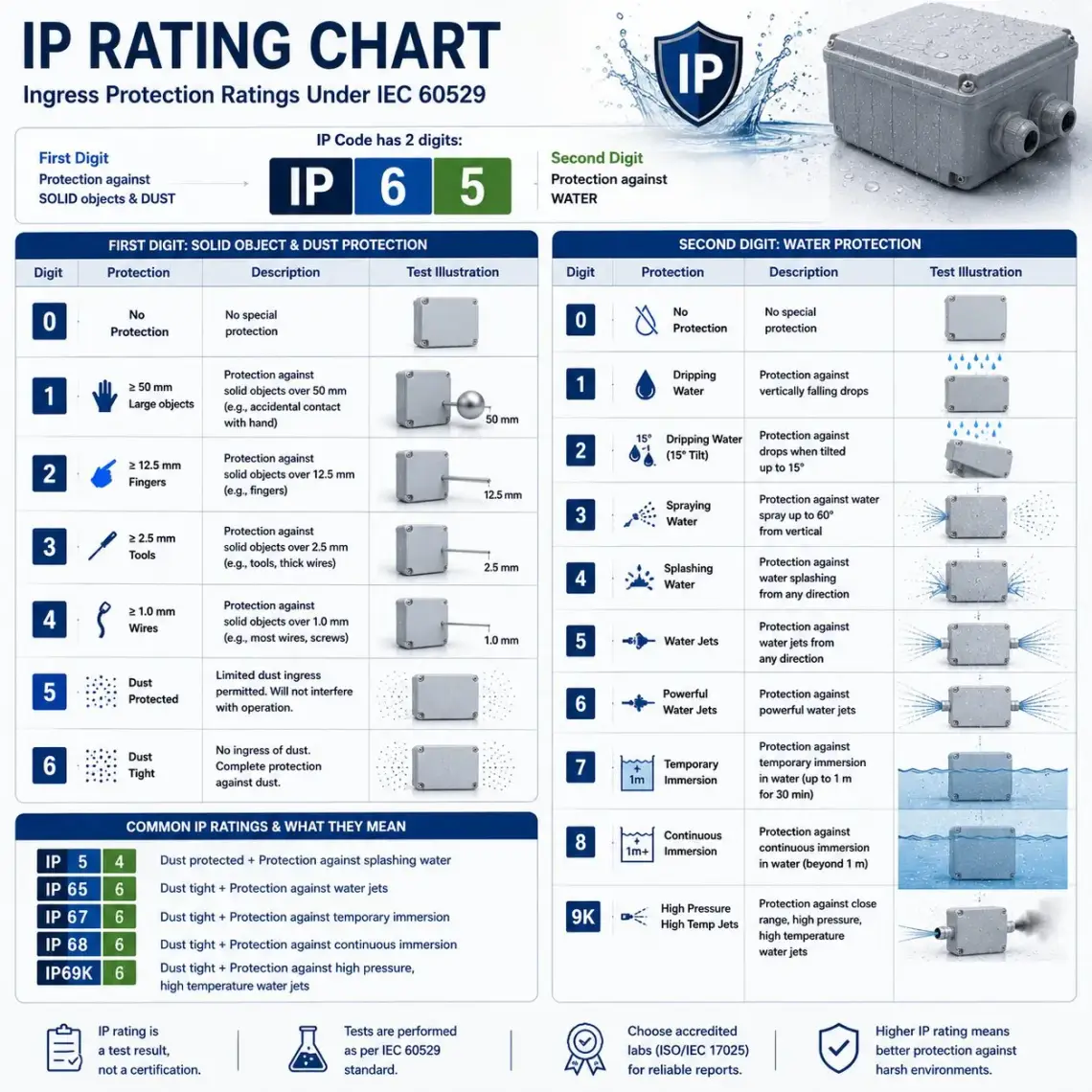
The IP code is read digit by digit. IP65 is "IP six five", not "IP sixty-five" — and the two digits are independent tests.
First Digit — Protection Against Solid Objects and Dust
Digit | Protects against | Test method |
0 | No protection | — |
1 | Solid objects ≥ 50 mm (back of hand) | 50 mm sphere probe |
2 | Solid objects ≥ 12.5 mm (finger) | 12.5 mm jointed test finger |
3 | Solid objects ≥ 2.5 mm (tools, thick wire) | 2.5 mm rod probe |
4 | Solid objects ≥ 1.0 mm (most wires, screws) | 1.0 mm wire probe |
5 | Dust protected — ingress not fully prevented, but not enough to interfere with operation | Dust chamber |
6 | Dust tight — no ingress of dust at all | Dust chamber under vacuum |
Second Digit — Protection Against Water
Digit | Protects against | Test method |
0 | No protection | — |
1 | Vertically falling drips | Drip box, 10 minutes |
2 | Drips at up to 15° tilt | Drip box, four positions |
3 | Spraying water up to 60° from vertical | Oscillating tube or spray nozzle |
4 | Splashing water from any direction | Oscillating tube, full 180° arc |
5 | Water jets from any direction | 6.3 mm nozzle |
6 | Powerful water jets | 12.5 mm nozzle |
7 | Temporary immersion — 1 m depth, 30 minutes | Immersion tank |
8 | Continuous immersion beyond 1 m | Conditions agreed with manufacturer |
9 / 9K | High-pressure, high-temperature jets | 80–100 bar at 80 °C |
The Trap Almost Everyone Falls Into
A higher second digit does not automatically include the lower ones.
Water digits 1 through 6 form a rising scale — a product that passes IPX6 will pass IPX5. But 7 and 8 are a different family. An enclosure can survive being fully submerged in still water yet fail under a pressurised jet, because immersion and jetting stress a seal in completely different ways.
This is why you see products marked IP65/IP67 or IP66/IP68 with two ratings. If your product needs to survive both jets and immersion, both tests must be performed and both must appear on the report. Asking for IP67 alone will not give you jet protection on paper.
IEC 60529: The IP Testing Standard
IEC 60529 — Degrees of protection provided by enclosures (IP Code) is the international standard that governs all of this. It is published by the International Electrotechnical Commission and adopted worldwide, including in India as IS/IEC 60529.
The standard specifies:
- The meaning of each digit in the IP code
- The exact test apparatus — nozzle diameters, flow rates, distances, chamber dimensions
- Test duration and sequence
- Sample mounting and orientation
- Pass/fail criteria for each degree
Because the standard is this prescriptive, results from one accredited laboratory are directly comparable to results from another. That is the entire value of testing to a published standard rather than to an in-house method.
A few sector-specific variants exist. ISO 20653 covers road vehicle electrical equipment and is where the IP6K9K style codes come from. IEC 60598 applies IP requirements to luminaires. If your product is going into automotive or lighting, confirm which document the buyer wants before booking.
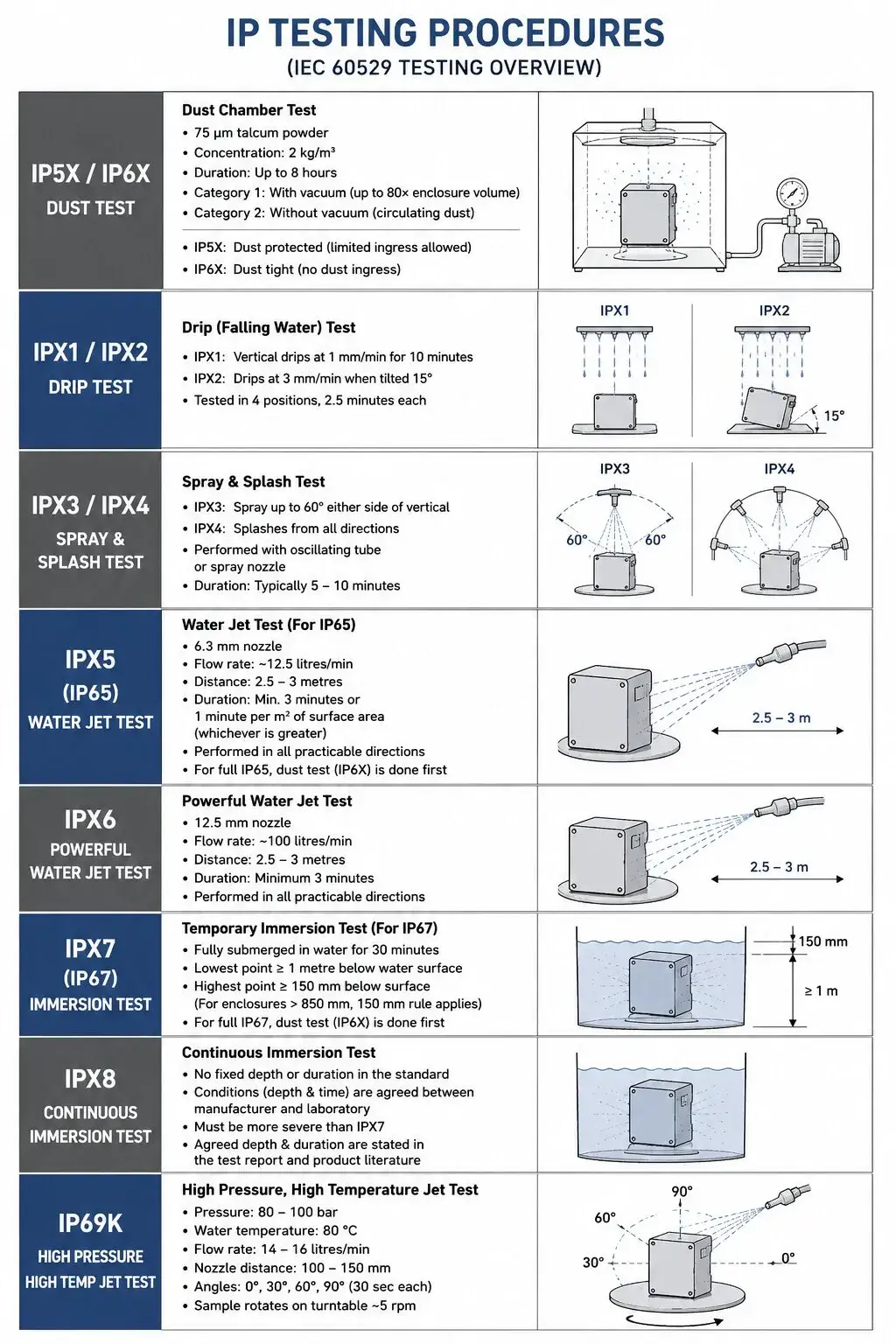
IP Testing Procedures: How Each Test Is Actually Performed
This is the part most exporters want and rarely find written plainly. Here is what physically happens in the lab.
IP5X and IP6X test procedure — dust testing
The sample is placed in a dust chamber containing fine talcum powder that passes through a 75 µm sieve, at a concentration of 2 kg of powder per cubic metre of chamber volume. The powder is kept in suspension by circulation.
The standard defines two categories:
- Category 1 — for enclosures where normal use creates a lower internal pressure than the surroundings. A vacuum is applied to draw air through the enclosure, typically up to 80 times the enclosure volume, for up to 8 hours.
- Category 2 — for enclosures that do not experience a pressure difference. The sample simply sits in the circulating dust, usually for 8 hours, with no vacuum.
Pass criteria differ between IP5X and IP6X:
- IP5X (dust protected) — some dust may enter, but not in a quantity or location that interferes with correct operation or impairs safety
- IP6X (dust tight) — no dust may be observed inside the enclosure at all
IPX1 and IPX2 — drip testing
The sample sits under a drip box that produces uniform artificial rainfall.
- IPX1 — water falls vertically at 1 mm/min for 10 minutes, sample in its normal position
- IPX2 — water falls at 3 mm/min, sample tilted 15° and tested in four positions, 2.5 minutes each
IPX3 and IPX4 — spray and splash testing
Performed either with an oscillating tube carrying spray nozzles, or a hand-held spray nozzle with a counterbalanced shield.
- IPX3 — spray up to 60° either side of vertical
- IPX4 — splashing from all directions, the tube swinging through the full 180° arc
Duration is typically 5–10 minutes depending on enclosure size.
IP65 test procedure — water jet testing (IPX5)
This is the most requested test, so it is worth stating precisely.
The enclosure is sprayed from all practicable directions using a 6.3 mm nozzle at a flow rate of approximately 12.5 litres per minute, from a distance of 2.5 to 3 metres. The test runs for a minimum of 3 minutes, or roughly 1 minute per square metre of enclosure surface area, whichever is greater.
For a full IP65, this water jet test is performed in addition to the IP6X dust-tight test. The dust test is normally carried out first.
IPX6 — powerful water jets
Same principle as IPX5, but significantly more severe:
- 12.5 mm nozzle
- Approximately 100 litres per minute
- 2.5 to 3 metres distance
- Minimum 3 minutes
This is the standard for outdoor equipment exposed to heavy sea or weather conditions, and for anything likely to be cleaned with a hose.
IP67 testing procedure — temporary immersion (IPX7)
The sample is fully submerged in water for 30 minutes. Depth is defined relative to the enclosure:
- The lowest point of the enclosure must be at least 1 metre below the water surface, and
- The highest point must be at least 150 mm below the surface
For enclosures taller than 850 mm, the 150 mm rule governs.
For a full IP67, this is performed alongside the IP6X dust test.
IPX8 — continuous immersion
IPX8 has no single fixed depth or duration in the standard. The conditions are agreed between the manufacturer and the laboratory, and must be more severe than IPX7. The agreed depth and time must then be stated on the test report and in your product literature — "IP68" on its own is meaningless without those parameters.
IP69K testing — high-pressure, high-temperature jets
The most demanding water test, used for food processing, pharmaceutical and vehicle equipment subject to steam cleaning:
- 80–100 bar pressure
- Water at 80 °C
- Flow of 14–16 litres per minute
- Nozzle at 100–150 mm distance
- Sprayed at 0°, 30°, 60° and 90°, for 30 seconds at each angle
- Sample rotating on a turntable at approximately 5 rpm
Common IP Ratings and What They Suit
Rating | Meaning | Typical products |
IP20 | Finger-safe, no water protection | Indoor control panels, consumer electronics |
IP44 | 1 mm objects, splashing water | Indoor lighting, domestic switchgear |
IP54 | Dust protected, splashing water | Indoor industrial equipment, some outdoor luminaires |
IP55 | Dust protected, water jets | Outdoor enclosures, junction boxes, sheltered equipment |
IP65 | Dust tight, water jets | Outdoor lighting, cameras, control panels, IoT devices, solar inverters |
IP66 | Dust tight, powerful jets | Marine equipment, hose-cleaned machinery |
IP67 | Dust tight, 1 m immersion | Handheld devices, automotive sensors, connectors, wearables |
IP68 | Dust tight, continuous immersion | Submersible pumps, underwater sensors, buried fittings |
IP69K | Dust tight, high-pressure steam cleaning | Food processing, pharma, commercial vehicles |
IP65 vs IP66 vs IP67 — how to choose
- Will it be rained on and occasionally hosed down? IP65 is usually correct and is the most commonly specified rating.
- Will it face heavy jets, sea spray or routine pressure washing? Go to IP66.
- Could it be dropped in water, or briefly submerged? You need IP67 — and if it also faces jets, specify IP65/IP67 as a dual rating.
- Is it permanently underwater? IP68, with the depth and duration explicitly agreed and documented.
Specifying higher than you need is a real cost. Each additional grade means tighter seals, more expensive gaskets, more assembly labour and, often, thermal management problems because a sealed box cannot breathe.
What Happens After the Test — Pass and Fail Criteria
Once the dust or water exposure is complete, the laboratory opens the enclosure and inspects it. The evaluation is not simply "did anything get in".
For water tests, the criterion is that any water which entered must not:
- Interfere with correct operation of the equipment
- Impair safety — particularly creepage and clearance distances, and insulation
- Reach live parts or windings not designed to operate wet
- Accumulate near a cable entry where it could enter the cable
Many laboratories follow the exposure with a dielectric strength or insulation resistance check and a functional check, since a small amount of harmless condensation is treated differently from water sitting on a PCB.
For dust tests, IP5X allows limited ingress that does not affect operation; IP6X allows none.
The most common reasons products fail
- Cable glands and entries — by a wide margin the single biggest failure point
- Display windows and membrane keypads — adhesive bond lines let go under jets
- Gasket compression — screws too far apart, or under-torqued, so the seal is uneven
- Vents and pressure equalisation membranes — often fine for IPX5 but not immersion
- Removable covers, battery doors and SIM flaps
- Assembly variation — a hand-built prototype seals better than production units
If a sample fails, you get a report explaining where ingress occurred. That is genuinely useful engineering feedback — fix the gland or the gasket, and retest.
Who Can Perform IP Testing? ISO/IEC 17025 Accredited Laboratories
Since IP is a test rather than a certification, the question is not "who is authorised to certify" but "whose report will be accepted".
The answer is: a laboratory holding ISO/IEC 17025 accreditation with IEC 60529 within its declared scope. In India that generally means NABL accreditation; equivalent bodies exist in other countries under the ILAC mutual recognition arrangement.
When choosing a laboratory, check that:
- IEC 60529 is genuinely listed in their accredited scope — not merely "available"
- They hold the specific apparatus for the digits you need, particularly the IPX6 12.5 mm jet rig, the immersion tank and, if required, the IP69K rig
- Their chamber and tank can physically accommodate your product's dimensions and weight
- The report format states the standard, the edition, the test conditions and the result clearly
What you need to send the lab:
- The sample, assembled exactly as it will ship, with all covers, glands and connectors fitted
- The target rating — IP54, IP65, IP67, or a dual rating
- A note on whether the product should be energised during testing
- The normal mounting orientation and any manufacturer-declared conditions for IPX8
- Ideally two samples, so a failure can be investigated without waiting for a second shipment
IP Testing in India: Cost and Turnaround
For most products, IP testing is one of the fastest and least expensive tests you will ever book.
- Typical cost: ₹9,000 to ₹12,000 per sample, depending on the size of the product and the handling required. Large, heavy or awkwardly mounted items sit at the upper end because they need special fixturing and more chamber time.
- Turnaround: from 24 hours. A standard IP65 or IP67 evaluation on a normally sized enclosure can typically be completed and reported within a day of the sample reaching the laboratory.
Two practical points that affect both figures:
- Dual ratings take longer. IP65/IP67 means two water tests plus a dust test, so plan for more than a single-rating job.
- The dust test is the long pole. An 8-hour dust chamber cycle sets the floor on turnaround for any IP5X or IP6X rating.
Need Help with IP Testing for Your Product?
IP testing is straightforward once you know which rating you actually need, which tests that implies, and which laboratory can handle your product's size and configuration. Getting those three things right the first time is what separates a one-day job from a three-week one.
Instacertify works with manufacturers, importers and exporters to arrange IP testing as per IEC 60529 through ISO/IEC 17025 accredited partner laboratories.
What we handle:
- Choosing the right rating. We will tell you whether you need IP54, IP65, IP67 or a dual rating for your application and your buyer's specification — before you pay for a test you do not need.
- The full range of degrees. IP4X through IP6X for solids, IPX1 through IPX9K for water, single or dual ratings.
- Fast turnaround — from 24 hours for standard products once the sample reaches the laboratory.
- Best pricing — typically ₹9,000 to ₹12,000 per sample, depending on product size and the handling required.
- Reports that get accepted. Issued against IEC 60529 by an accredited laboratory, in the format tenders, buyers and notified bodies expect.
- Design feedback on failures. If a sample fails, we help you understand where the ingress occurred so the retest passes.
- The wider compliance file. If your product also needs BIS, CE, RoHS, EMC, WPC, LMPC or EPR documentation, it is handled by the same team.
Talk to the Instacertify testing experts for the right rating, the best price and the fastest report.
Frequently asked questions
Is there an IP certificate?
No. IEC 60529 defines a test, not a certification scheme. What exists is a test report from an accredited laboratory, on the basis of which the manufacturer declares the rating.
How long is an IP test report valid?
There is no expiry date. The report describes the sample as tested. If the enclosure, gasket material, cable gland or assembly process changes, the report no longer represents the product and retesting is required. Many buyers ask for a report no older than two or three years.
Does IP67 mean the product is also IP65?
Not automatically. Immersion and jet testing stress seals differently. If both are needed, both must be tested and both must appear on the report.
Can I test to IP66 and claim IP65?
Within the water scale, 1 to 6 is cumulative, so a genuine IPX6 pass covers IPX5. Good practice, and what most buyers expect to see, is that the rating you claim is the rating on the report.
Does the product have to be switched on during the test?
It depends on the product standard and the intended use. Some equipment is tested energised, some de-energised. Agree this with the laboratory before testing, and make sure the report states which was done.
What is IP69K, and is it in IEC 60529?
IP69K originated in the German DIN 40050-9 standard for road vehicles and is now in ISO 20653. The equivalent high-pressure, high-temperature test was added to IEC 60529 as IPX9. In practice buyers use the terms interchangeably — confirm which document they want cited.
Is IP the same as NEMA?
No. NEMA enclosure types are a North American system that also covers corrosion, icing and construction requirements. The two can be roughly cross-referenced, but they are not equivalent and a NEMA rating cannot simply be converted into an IP rating on paper.
