Indian Compliance
IS 2347 Pressure Cooker ISI Mark: QCO Date, Test Parameters, BIS Fees & Licence Process
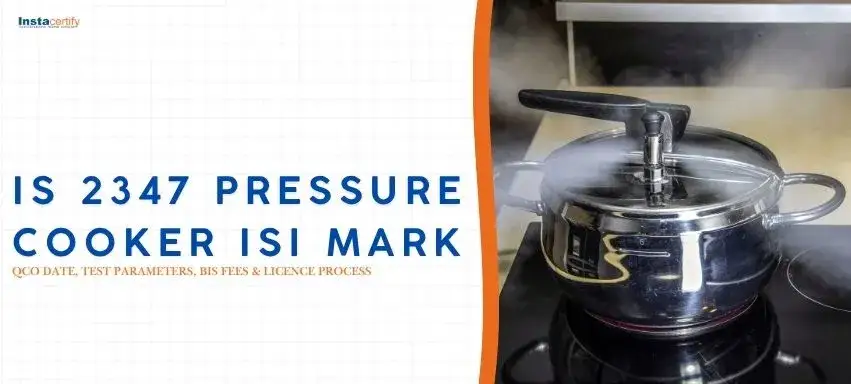
IS 2347:2017 is the Indian Standard for domestic pressure cookers, and the ISI mark under it has been mandatory since 1 February 2021 under the Domestic Pressure Cooker (Quality Control) Order, 2020. Every cooker from 1 to 22 litres – aluminium, stainless steel, inner-lid or outer-lid, stovetop or induction-base – sold or imported in India must carry the BIS Standard Mark. This guide covers the QCO, the tests a cooker must pass, the BIS licence process for Indian factories (ISI) and foreign factories (FMCS), fees and realistic timelines.
[IMAGE PLACEHOLDER – Graphic: ISI mark on a pressure cooker with the key IS 2347 safety devices labelled]
Insert image here; add descriptive alt text with the primary keyword.
What is IS 2347?
IS 2347:2017, "Domestic Pressure Cookers – Specification", sets requirements for materials, design, construction, safety devices, performance and marking of pressure cookers for household use. It replaced IS 2347:1997 and aligns with modern safety expectations: a pressure-regulating device, a safety valve or fusible plug, a gasket-release or over-pressure relief mechanism, and secure handles and lid locking. The standard is administered by BIS under the ISI (Scheme I) product-certification scheme.
The Domestic Pressure Cooker QCO 2020: key dates and scope
| Item | Detail |
|---|---|
| Order | Domestic Pressure Cooker (Quality Control) Order, 2020, issued by DPIIT, Ministry of Commerce & Industry |
| Date of effect | 1 February 2021 |
| Standard | IS 2347:2017 |
| Covers | Domestic pressure cookers of 1–22 litres capacity, including inner-lid, outer-lid, hard-anodised, stainless steel and induction-compatible cookers |
| Excludes | Commercial/industrial pressure vessels, electric pressure cookers (covered separately under IS 302-2-15 / CRS where applicable) |
| Applies to | Manufacturers, importers, brand owners and e-commerce sellers |
| Penalty | Imprisonment up to 2 years and/or fine from ₹2 lakh (first offence) under the BIS Act, 2016; seizure of stock |
IS 2347 test parameters: what BIS tests on a pressure cooker
| Test / requirement | What it checks |
|---|---|
| Material composition | Food-grade aluminium alloys (e.g., IS 21 / IS 617 grades) or AISI 304-grade stainless steel; gasket of food-grade rubber/silicone |
| Wall thickness and dimensions | Minimum body and lid thickness by capacity |
| Proof pressure test | Body and lid withstand a pressure well above operating pressure without permanent deformation or leakage |
| Bursting pressure test | Cooker must not burst below the specified multiple of working pressure |
| Pressure-regulating device (weight valve) test | Opens at the rated operating pressure within tolerance |
| Safety valve / fusible plug test | Operates at the specified over-pressure before dangerous build-up |
| Gasket release / over-pressure relief test | Gasket or relief system vents when the primary and secondary devices fail |
| Lid-locking and lid-opening test | Lid cannot be opened while under pressure |
| Handle strength and heat-resistance test | Handles bear load and remain below temperature limits |
| Operating / cooking performance test | Reaches and holds operating pressure; steam leakage within limits |
| Thermal shock and endurance | Repeated cycles without failure |
| Marking | Manufacturer, capacity, working pressure, batch, ISI mark with licence (CM/L) number |
[IMAGE PLACEHOLDER – Flowchart: BIS ISI licence process for pressure cookers (ISI vs FMCS routes)]
Insert image here; add descriptive alt text with the primary keyword.
How to get a BIS ISI licence for pressure cookers
Route 1 – Indian manufacturers (ISI, Scheme I)
- Set up in-house testing. BIS requires the factory to have the test equipment listed in the Scheme of Inspection and Testing (SIT) – pressure-test rig, gauges, dimension tools, hardness tester, etc.
- Apply online on the BIS Manak portal with the factory layout, machinery list, test-equipment list, quality-control plan, trademark and product drawings.
- Factory inspection by a BIS officer: verification of manufacturing, in-house testing and drawing of samples.
- Independent testing of samples in a BIS-recognised laboratory against IS 2347.
- Grant of licence (CM/L number) on satisfactory report; typically 30–60 days from application under the simplified procedure.
- Marking and surveillance: apply the ISI mark, pay marking fees, maintain test records; BIS conducts periodic inspections and market sampling.
Route 2 – Foreign manufacturers (FMCS)
Overseas factories exporting cookers to India apply under the Foreign Manufacturers Certification Scheme, nominate an Authorised Indian Representative (AIR), host a BIS inspection at the overseas plant (inspector travel paid by applicant) and submit a performance bank guarantee. Timelines are 4–6 months. Instacertify acts as AIR for foreign brands.
Documents required
- Business registration, GST, factory licence / MSME certificate
- Trademark registration or authorisation
- Manufacturing process flow chart and machinery list
- Test-equipment list with calibration certificates
- Product drawings, material test certificates for aluminium/steel/gasket
- In-house test reports as per the SIT
- Details of quality-control personnel
- For FMCS: AIR nomination, undertaking and bank-guarantee documents
BIS ISI certification fees for pressure cookers (indicative)
| Fee | Amount |
|---|---|
| Application fee | ₹1,000 |
| Inspection charges (per man-day) | ₹7,000 (domestic); higher plus travel for FMCS |
| Sample testing charges (BIS-recognised lab) | ₹25,000 – ₹60,000 per variety |
| Annual licence fee | ₹1,000 |
| Marking fee (annual, minimum) | ₹1,00,000 or unit-rate based on production, whichever is higher (MSME concessions available) |
| Consulting and documentation (Instacertify) | Quoted per site |
Fees are per factory and per standard; multiple capacities and models under IS 2347 can be covered by one licence with varieties listed. Check the latest BIS fee schedule before budgeting – MSMEs get an 80% concession on minimum marking fee in the first year in several categories.
Timeline
- Preparation and in-house lab set-up: 2–4 weeks
- BIS application to inspection: 2–4 weeks
- Sample testing: 3–5 weeks
- Total (Indian manufacturer): about 6–10 weeks; FMCS: 4–6 months
Importers and e-commerce sellers: what you must check
Only cookers bearing a valid ISI mark with a CM/L number may be imported or listed online. Verify the licence on the BIS "Know Your Standards" / licence-search page, keep the manufacturer's licence copy with each consignment, and expect customs to check the mark. Unmarked stock is liable to seizure.
How Instacertify helps
Instacertify Labs provides end-to-end BIS ISI support for pressure cooker manufacturers in India and abroad – in-house lab specification, documentation, application, inspection coordination, testing through BIS-recognised laboratories and AIR services under FMCS. See BIS ISI mark for domestic manufacturers, BIS FMCS for foreign manufacturers and our guides on ISI for gas stoves and IS 302-2-6 electric stoves. Contact us for a free consultation.
Frequently asked questions
Is the ISI mark mandatory for pressure cookers in India?
Yes. Under the Domestic Pressure Cooker (Quality Control) Order, 2020, effective 1 February 2021, all domestic pressure cookers must conform to IS 2347:2017 and carry the ISI mark.
What is the IS number for domestic pressure cookers?
IS 2347:2017 – Domestic Pressure Cookers – Specification.
What capacities does IS 2347 cover?
Household cookers from 1 litre up to 22 litres, in aluminium, hard-anodised aluminium and stainless steel.
How long does BIS certification for pressure cookers take?
Roughly 6–10 weeks for an Indian factory; 4–6 months for a foreign factory under FMCS.
Can an importer get the ISI mark instead of the manufacturer?
No. The licence is granted to the manufacturing site. Importers must source from licensed factories or help the foreign factory obtain FMCS certification.
Which tests are performed under IS 2347?
Material, dimensions, proof pressure, bursting pressure, pressure-regulating device, safety valve/fusible plug, gasket release, lid locking, handle strength, operating performance and marking.