Indian Compliance
Top LMPC Compliance Requirements Every Importer Must Know (2026)
Did you know? Non-compliance with the Legal Metrology rules can lead to penalties, detention of goods or delay in customs clearance for import or sale of pre-packaged products in India. If you are an importer, producer, or e-commerce seller, you must know about LMPC Registration to make sure that your items are complying with the Indian laws before they enter the market.
If you are involved in packaged goods in India, this guide will help you understand what is LMPC, who needs LMPC Registration, the registration process, documents required, labelling requirements, validity, penalties and the latest compliance updates for 2026.
What is LMPC?
LMPC means Legal Metrology Packaged Commodities. It is the rules for manufacture, import, packing, distribution, sale and labelling of pre-packaged commodities in India.
LMPC seeks to make sure that customers have complete and accurate information on packaged products at the time of purchase. It also encourages transparency,fair trade practices and standardisation of labelling for all sectors.
Regulation of LMPCcompliance is:
- The Legal Metrology Act, 2009
- Legal Metrology (Packaged Commodities) Rules, 2011
- Notifications and rules from time to time published by the Department of Consumer Affairs
Businesses manufacturing, importing, packing or selling packaged products will have to abide by these regulations before putting products for sale in the Indian market.
Why is LMPC Registration Important?
It is not only a legal requirement to register an LMPC, but it is an important step to protect the business and the consumer as well.
Benefits of LMPC Registration For Companies Easy Customs Clearance Improves Product Credibility Lowers The Risk of Penalties It ensures that consumers have access to clear information about the quantity of products, their price, the name of the manufacturer or importer and other essential declarations.
Some of the key benefits include:
- Compliance With Indian Laws
- More trust by consumers
- Faster customs clearance of imported products
- Lower risk of product confiscation
- Greater market acceptance
- Protection against unfair trade practices:
- Greater clarity around product labelling
What is an LMPC Certificate?
The LMPC Certificate is a formal registration given by the respective Legal Metrology body to the authorised importers, makers or packers of pre-packaged commodities.
The certificate confirms the applicant has completed the registration process and is authorised to deal with packaged items as per the applicable Legal Metrology regulations.
LMPC Registration is an important compliance step for importers before marketing imported packaged goods in India.
Objectives of LMPC Regulations
To provide uniform standards for packaged commodities being sold in India, Legal Metrology framework has been developed.
Its principal objectives are:
- Protection of consumers’ interests
- Upholding fair trading practices
- Encouraging the disclosure of correct amounts
- Standardising Package Labels
- Quit misrepresenting claims
- Support pricing transparency
- Enhancing regulatory compliance
These objectives assist maintain confidence in the Indian economy and ensure that enterprises compete on a level playing field.
Who Needs LMPC Registration?
In most cases, businesses engaged in the manufacturing, importing, packing or distributing of pre-packaged commodities are required to be registered for LMPC.
Entities normally requiring LMPC Registration are:
Importers
Companies importing packaged products into India for sale, distribution or commercial use.
Examples:
- Electronics importers
- Cosmetics importers
- Food importers
- Importers of medical devices
- Importers of household products
- Suppliers of industrial equipment
Manufacturers
Manufacturers producing packaged products for sale in India may need to comply with the applicable Legal Metrology provisions and labeling requirements.
Packers
Businesses that pack or repack products into retail packages before sale.
Brand Owners
Companies selling products under their own brand names while outsourcing manufacturing or packaging.
E-commerce Sellers
Businesses selling packaged products through online marketplaces are also expected to ensure that mandatory declarations are correctly displayed on product packaging and, where applicable, on online listings in accordance with the Legal Metrology framework.
Which Products Require LMPC Compliance?
LMPC requirements apply to a wide range of packaged commodities sold in India.
Some common examples include:
- Electrical appliances
- Mobile phones
- Electronic accessories
- Kitchen appliances
- Cosmetics
- Personal care products
- Packaged food items
- Beverages
- Household cleaning products
- Paints
- Lubricants
- Toys
- Stationery
- Medical devices
- Consumer goods
- Imported retail products
The applicability depends on the nature of the product, packaging, intended sale, and the relevant provisions under the Legal Metrology (Packaged Commodities) Rules.
Who Does Not Need LMPC Registration?
Some transactions or items may not be covered under certain provisions of LMPC or may be exempted under the Legal Metrology (Packaged Commodities) Rules.
Examples of such could be:
- Rules exempt parcels
- Relevant institutional or industry packages
- Products covered under some exemption notifications
- (10) Packages not for retail sale according to the restrictions applicable
Exemptions vary according to type of product, packaging, quantity and intended use. Businesses should carefully assess their obligations before assuming registration is not required.
Mandatory Declarations Under LMPC
Correct labelling of packages is one of the most critical components of LMPC compliance.
Each appropriate package shall bear the required declarations in a clear and legible manner.
Typical declarations are:
- Name and address of maker, packer or importer
- Country of origin (if applicable for imported goods)
- Commodity common or generic name
- Net Content
- Month and year of manufacture, packing or import, as the case may be
- Maximum Retail Price (MRP) inclusive of all applicable taxes
- Customer care information
- Dimensions or quantity, if applicable
- Any further declarations required by the applicable rules
False, misleading or incomplete statements may result in regulatory action.
Latest LMPC Updates in India (2026)
The Legal Metrology framework keeps evolving to increase consumer protection, ease compliance and improve transparency in both offline and online business. Businesses must keep up with the latest revisions to prevent compliance difficulties.
Some of the main developments include:
1. More Focus on E-commerce Compliance
The Government has added new compliance requirements for online marketplaces dealing with imported products. Under the recent modifications, e-commerce businesses will be forced to offer clearer information on products, including details of the country-of-origin for imported products via searchable product listings.
2. Increased Transparency in Product Labelling
Authorities continue to stress on correct disclosure of product quantities, importer or manufacturer information, MRP, customer care details and other essential package declarations in order to boost consumer confidence.
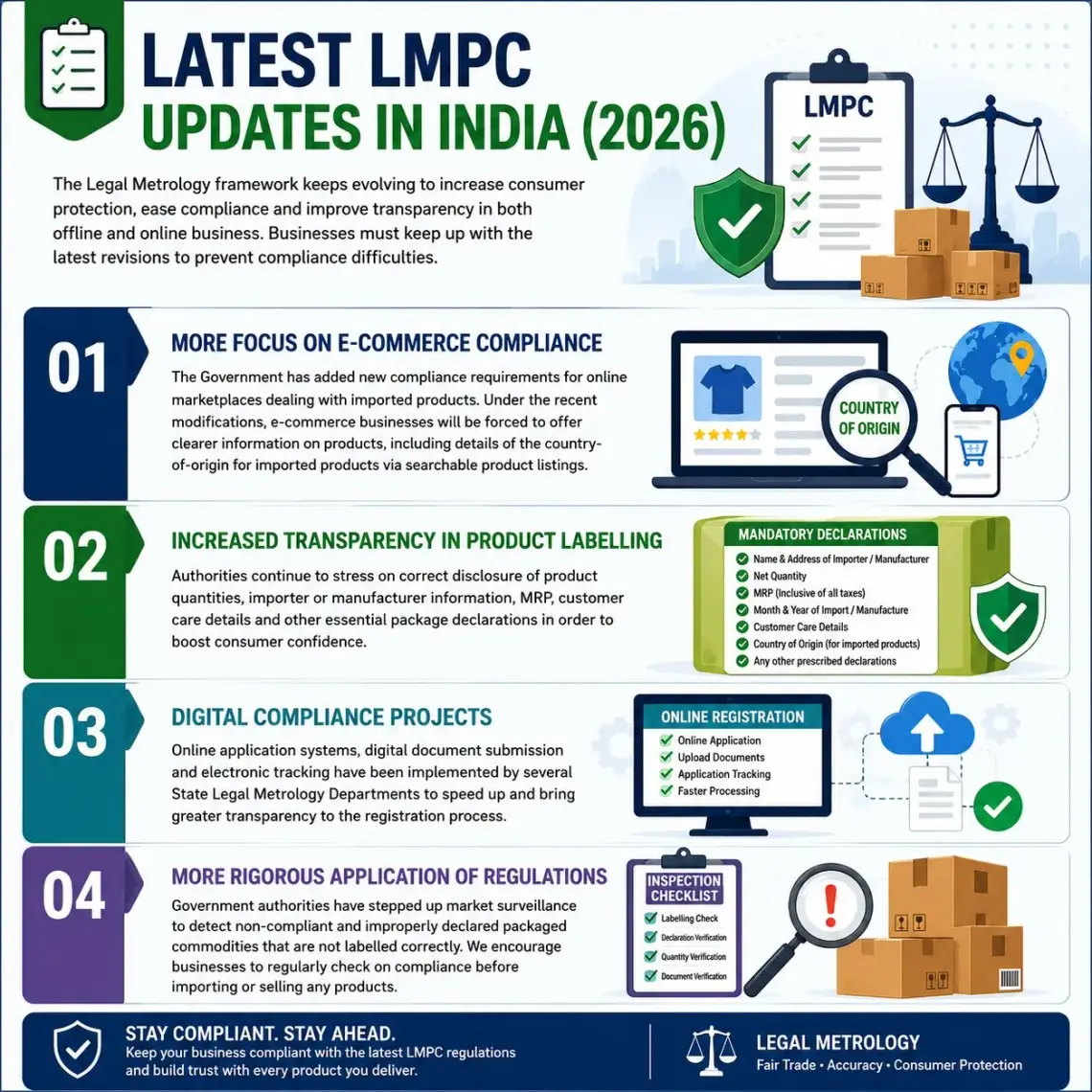
3. Digital Compliance Projects
Online application systems, digital document submission and electronic tracking have been implemented by several State Legal Metrology Departments to speed up and bring greater transparency to the registration process.
4. More Rigorous Application of Regulations
Government authorities have stepped up market surveillance to detect non-compliant and improperly declared packaged commodities that are not labelled correctly. We encourage businesses to regularly check on compliance before importing or selling any products.
Validity of LMPC Registration
Depending on the authority that applies and the registration that is issued, LMPC Registration may be valid. Companies should check the date on their registration certificate and make sure to renew or amend it if necessary before the expiry date.
Having a legal registration helps to prevent disruptions to your firm when importing, customs clearance or market inspections occur.
Common Reasons for LMPC Application Rejection
Many LMPC applications get delayed because of avoidable mistakes.
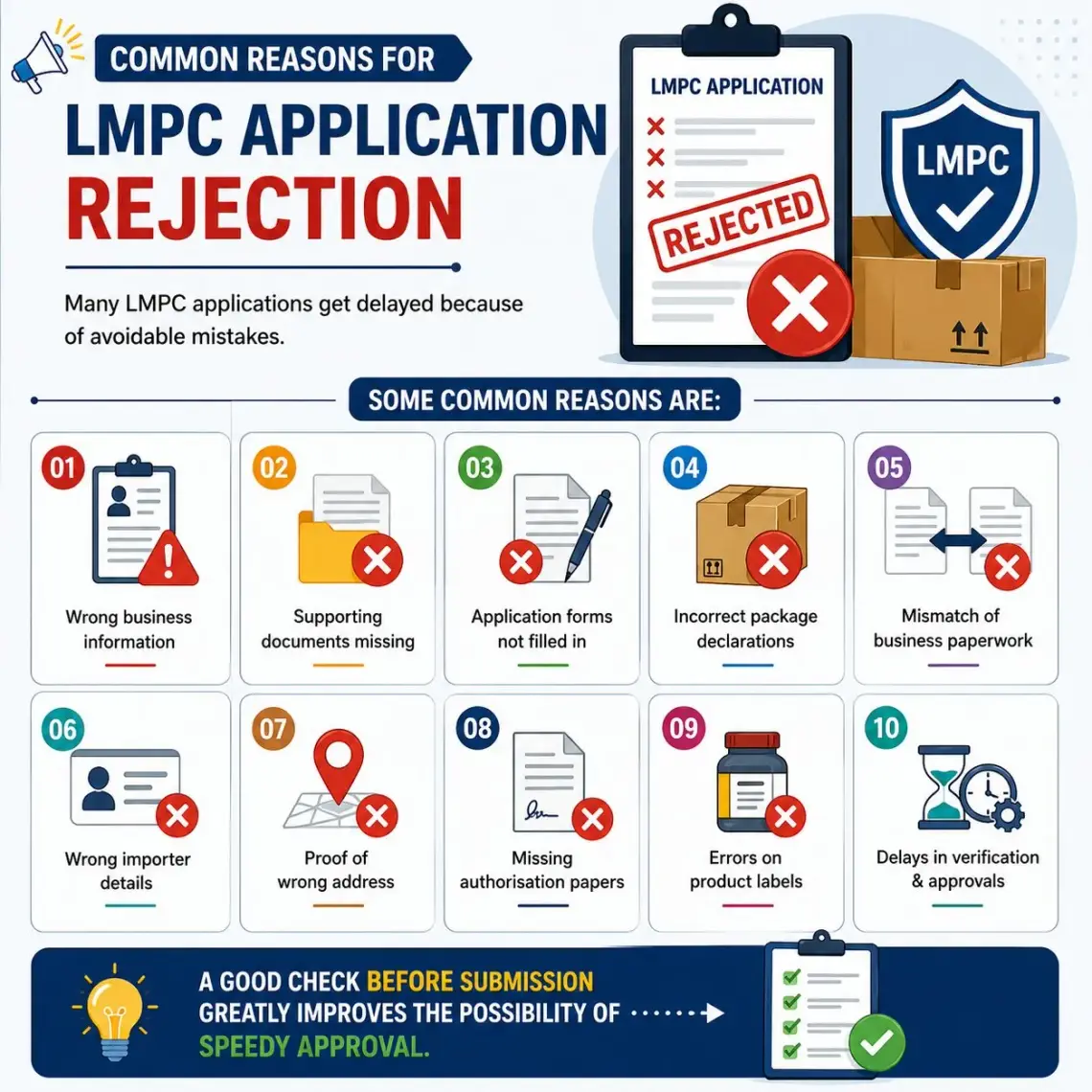
Some common reasons are:
- Wrong business information
- Supporting documents missing
- Application forms not filled in
- Incorrect package declarations
- Mismatch of business paperwork
- Wrong importer details
- “Proof of wrong address”
- Missing authorisation papers
- Errors on product labels
A good check before submission greatly improves the possibility of speedy approval.
Penalties for Non-Compliance
If the violation is found to be a violation of the Legal Metrology Act and the Packaged Commodities Rules, then regulatory action may be taken depending upon the nature and severity of the violation.
The possible consequences are:
- Monetary fines
- Product seizure or forfeiture
- Customs clearance delays
- Directions to remedy labelling shortcomings
- Suspension of business activities in extreme instances
- “Legal action under relevant provisions
Regular compliance reviews help keep businesses away from such unnecessary risks.
Common Mistakes Businesses Should Avoid
Many businesses unknowingly violate LMPC requirements by overlooking small but important details.
Here are some common mistakes to avoid:
- Importing merchandise without verifying if LMPC applies
- Printing of wrong MRP
- Missing importers information
- False statements of net quantities
- Customer care information excluded
- Incorrect declaration of country of origin where applicable
- Use of Old Label Artwork
- Selling prior to meeting compliance criteria
- No updates on Legal Metrology Rules
- Default assumption is all packaged goods are exempt.
Frequently asked questions
What does LMPC stand for?
LMPC stands for Legal Metrology Packaged Commodities. It regulates the labeling, packaging, import, manufacture, and sale of pre-packaged commodities in India to ensure transparency, accurate declarations, and consumer protection under the Legal Metrology framework.
Is LMPC Registration mandatory for importers?
Yes. Importers dealing with applicable pre-packaged commodities are generally required to comply with the Legal Metrology framework before selling or distributing products in India. Compliance helps avoid customs delays and regulatory issues.
Which products require LMPC Registration?
Many consumer products sold in pre-packaged form, including electronics, cosmetics, food items, household goods, toys, medical devices, and other retail products, may fall under the applicable Legal Metrology requirements depending on their packaging and intended sale.
What documents are required for LMPC Registration?
Commonly required documents include the business registration certificate, GST certificate, Import Export Code (where applicable), PAN, address proof, identity proof of the authorized signatory, product details, packaging artwork, and supporting authorization documents.
Is LMPC applicable to e-commerce sellers?
Yes. Businesses selling packaged commodities through online marketplaces must ensure that mandatory product declarations comply with the applicable Legal Metrology provisions. Recent amendments have also introduced additional requirements relating to country-of-origin information for imported products sold online.
Can customs stop imported goods without LMPC compliance?
If imported products do not meet applicable Legal Metrology requirements, authorities may raise compliance queries or detain goods until deficiencies are addressed, depending on the circumstances and applicable regulations.
What information must appear on product packaging?
Applicable packages generally require declarations such as product name, manufacturer or importer details, net quantity, MRP, month and year of manufacture or import (as applicable), customer care details, and other mandatory information prescribed under the Rules.
What happens if product labels contain incorrect information?
Incorrect or misleading declarations may lead to penalties, product detention, corrective actions, or other enforcement measures under the Legal Metrology framework. Businesses should verify all label information before placing products on the market.