Indian Compliance
Skyrocket Lab Profits: How NABL Certification Unlocks the 15% CGHS Premium
Let's face it: in the world of testing, calibration, and medical diagnostics, trust is your ultimate currency. You can invest millions in state-of-the-art equipment and hire the most brilliant technicians, but if your clients—whether they are patients, manufacturers, or government bodies—cannot implicitly trust your test reports, your business will struggle to grow.
This is exactly where NABL Accreditation steps in.
A test report without accreditation is just a piece of paper with numbers on it. A test report backed by NABL is a universally accepted guarantee of accuracy, quality, and technical competence. If you are looking to scale your laboratory operations in India or globally, securing this accreditation isn't just a regulatory box to check; it is a strategic business move.
Let’s break down everything you need to know about NABL, from the step-by-step procedure to the actual costs involved, in simple, human terms.
What Exactly is NABL?
NABL stands for the National Accreditation Board for Testing and Calibration Laboratories. Operating as an autonomous body under the Quality Council of India (QCI), its mission is simple but critical: to assess and certify the technical competence of laboratories.
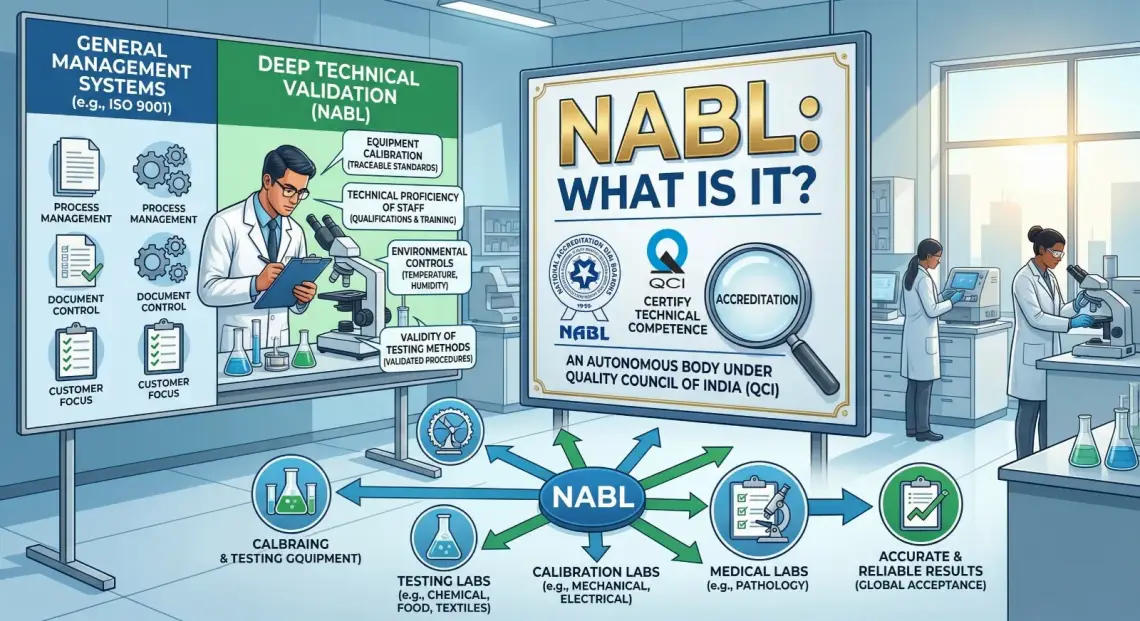
Unlike a basic ISO 9001 certification, which only evaluates your general management systems, NABL dives deep into the science of your operations. Assessors will scrutinize your equipment calibration, the technical proficiency of your staff, your environmental controls, and the validity of your testing methods.
Why Your Lab Absolutely Needs NABL Accreditation
Getting accredited takes time, effort, and money. So, why do thousands of labs across India willingly go through the rigorous process?
1. The Global Passport (International Recognition)
NABL is a full member of the International Laboratory Accreditation Cooperation (ILAC) and the Asia Pacific Accreditation Cooperation (APAC). Because of these Mutual Recognition Arrangements (MRAs), a test report generated by your NABL-accredited lab in Mumbai or Delhi is officially recognized in the United States, Europe, Japan, and beyond. It eliminates the need for product re-testing when goods are exported.
2. Winning Government and Corporate Contracts
If you want to bid on lucrative government tenders or partner with massive multinational corporations, NABL accreditation is almost always a mandatory prerequisite. From the Bureau of Indian Standards (BIS) to the Food Safety and Standards Authority of India (FSSAI), regulators heavily rely on NABL-accredited labs for compliance testing.
3. Zero Compromise on Patient and Consumer Safety
For medical laboratories, an incorrect diagnosis due to a faulty blood test can be a matter of life and death. For material testing labs, passing a weak batch of steel can lead to structural failures. NABL forces your lab to adopt an airtight Quality Management System (QMS) that drastically reduces human and mechanical errors.
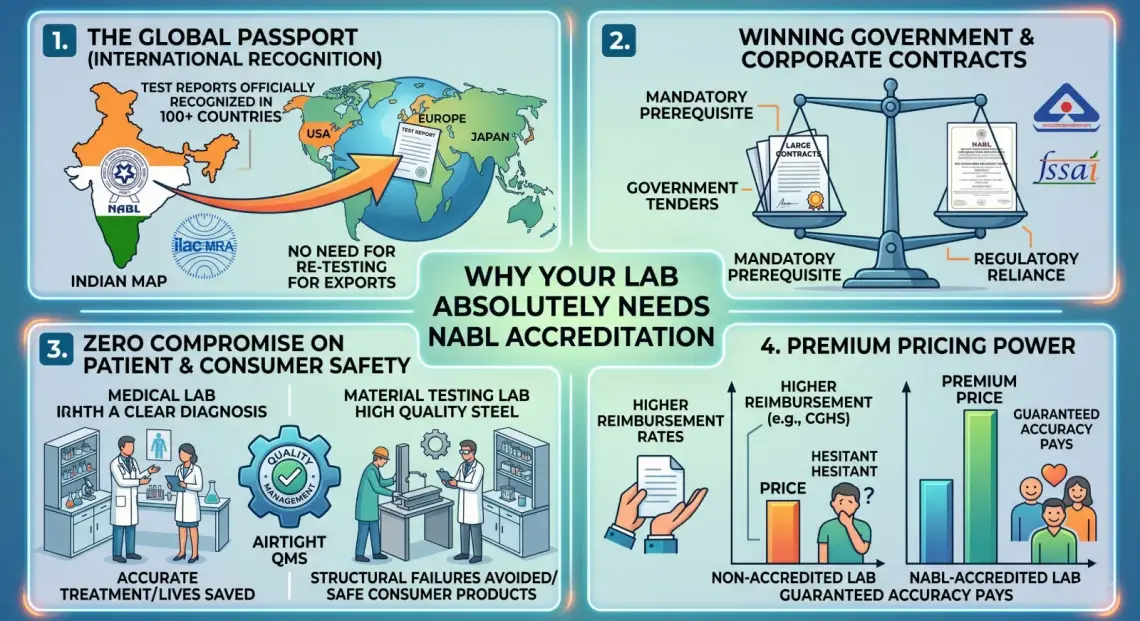
4. Premium Pricing Power
Accreditation elevates your brand. Customers are willing to pay a premium for guaranteed accuracy. In fact, under many government health schemes (like CGHS), NABL-accredited medical labs are legally entitled to higher reimbursement rates than their non-accredited competitors.
Which Standard Applies to Your Lab?
Before you begin the procedure, you need to know which international standard your lab will be assessed against:
- ISO/IEC 17025: For Testing and Calibration Laboratories (e.g., chemical, mechanical, electrical, electronics, and environmental testing).
- ISO 15189: For Medical and Clinical Laboratories (e.g., pathology, biochemistry, microbiology).
- ISO/IEC 17043: For Proficiency Testing Providers.
- ISO 17034: For Reference Material Producers.
Step-by-Step Procedure for NABL Accreditation
The journey to accreditation is a marathon, not a sprint. Typically, a lab needs to be fully operational for at least six months with documented test records before applying. Here is the roadmap to getting certified:
Step 1: Gap Analysis and Preparation
Don't rush to the application portal. Start by purchasing the relevant ISO standard (like ISO 17025) and conducting a brutal, honest internal audit. Where do your current operations fall short of the standard? Identify gaps in your equipment calibration, staff training records, and daily operating procedures.
Step 2: Building Your QMS Documentation
You need to document everything. You will build a comprehensive Quality Manual, draft precise Standard Operating Procedures (SOPs) for every single test you perform, and create standard forms for recording data. If a process isn't documented, as far as an auditor is concerned, it doesn't exist.
Step 3: Equipment Calibration and Traceability
Every piece of measuring equipment in your lab must be calibrated by an already-accredited NABL calibration lab. This ensures that your measurements are strictly traceable to national or international standards (like the National Physical Laboratory - NPL).
Step 4: Proficiency Testing (PT)
You must prove your lab can hold its own against others. You will participate in Proficiency Testing (PT) or Inter-Laboratory Comparisons (ILC). Essentially, you and several other labs will test the exact same sample. If your results match the established benchmark, you prove your technical competence.
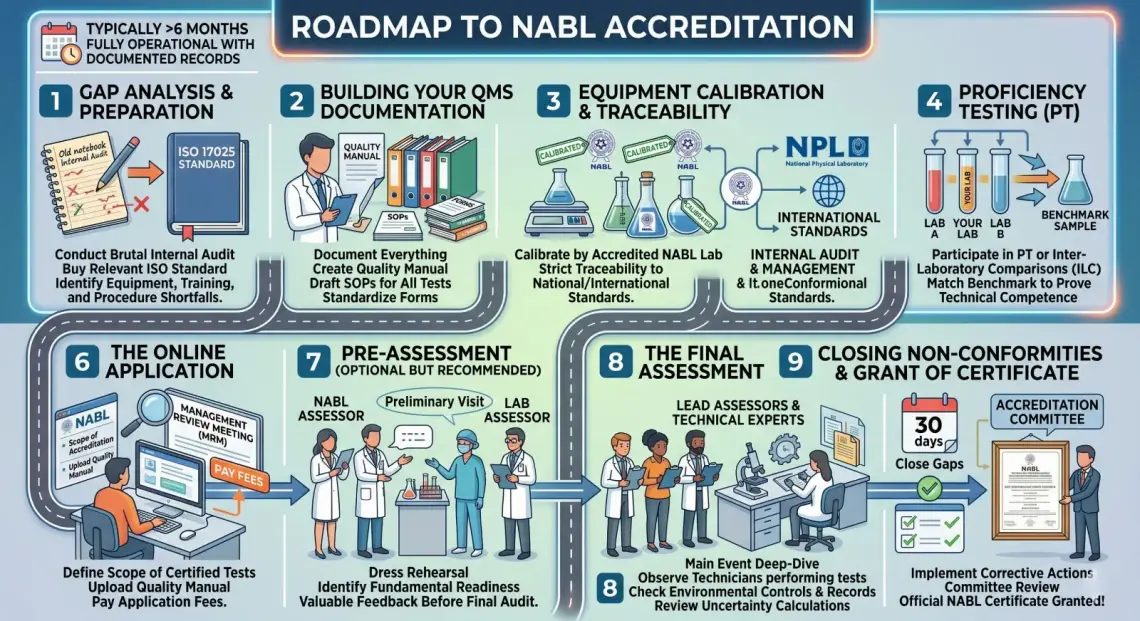
Step 5: Internal Audit and Management Review
Before NABL steps in, you must conduct a full internal audit and a Management Review Meeting (MRM). Find your own mistakes, document them as "non-conformities," and fix them.
Step 6: The Online Application
Head over to the NABL portal. You will define your exact "Scope of Accreditation" (which specific tests and parameters you want to be certified for), upload your Quality Manual, and pay the application fees.
Step 7: Pre-Assessment (Optional but Highly Recommended)
NABL will send an assessor for a preliminary visit. They aren't there to pass or fail you; they are there to tell you if you are fundamentally ready for the final audit. It’s a vital dress rehearsal.
Step 8: The Final Assessment
This is the main event. A team of NABL lead assessors and technical experts will visit your lab for a deep-dive inspection. They will observe your technicians performing tests, check your environmental controls, review your uncertainty calculations, and comb through your records.
Step 9: Closing Non-Conformities and Grant of Certificate
If the assessors find minor issues, you will be given time (usually 30 days) to implement corrective actions. Once NABL is satisfied that all gaps are closed, the Accreditation Committee reviews your file and officially grants your NABL Certificate!
Decoding the Cost of NABL Accreditation
How much does this all cost? The honest answer is: it depends on your size and scope. NABL fees are structured logically, scaling up based on the complexity and volume of the laboratory.
Here is a general breakdown of the official NABL fee structure (excluding GST) to help you budget:
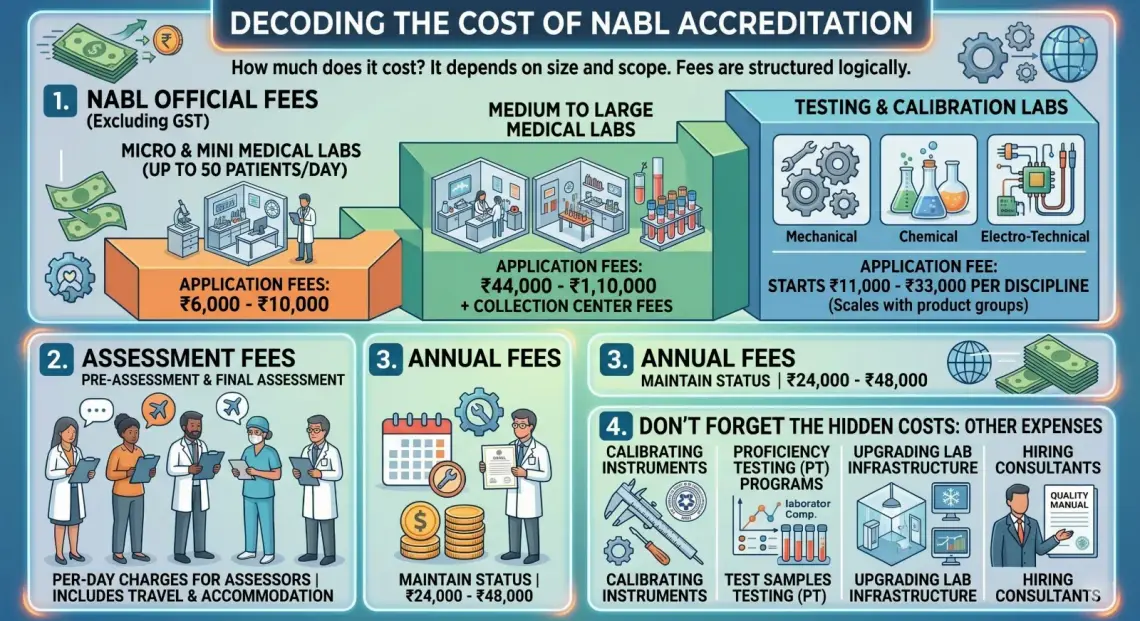
- Micro & Mini Medical Labs (Up to 50 patients/day): Application fees range from ₹6,000 to ₹10,000.
- Medium to Large Medical Labs: Application fees scale from ₹44,000 up to ₹1,10,000, plus small fees for sample collection centers.
- Testing and Calibration Labs: The application fee typically starts around ₹11,000 to ₹33,000 per discipline (e.g., Mechanical, Chemical, Electro-Technical), but can increase significantly based on how many product groups you add to your scope.
- Assessment Fees: You are responsible for paying the per-day charges for the assessors during the pre-assessment and final assessment stages, along with their travel and accommodation.
- Annual Fees: Once accredited, labs pay an annual fee to maintain their status, generally ranging between ₹24,000 and ₹48,000.
Don't Forget the Hidden Costs:
When budgeting, remember that the NABL fees are only one piece of the puzzle. You must also account for the costs of calibrating your instruments, participating in Proficiency Testing programs, upgrading your lab infrastructure to meet environmental requirements, and potentially hiring consultants to help you build your Quality Manual.
Bottom Line
Achieving NABL accreditation is a rigorous, demanding process that requires a total cultural shift within your laboratory. It demands meticulous attention to detail, continuous staff training, and an unwavering commitment to quality.
However, the payoff is massive. Accreditation transforms your laboratory from a local player into a globally recognized, legally defensible, and highly profitable enterprise. It proves to the world that when your lab speaks, the science is sound.
Frequently asked questions
Can a single stamp take my lab reports global?
Yes! Thanks to ILAC and APAC global pacts, NABL accreditation acts as an international passport for your test data. It permanently eliminates costly re-testing roadblocks when your retail clients export products to major global markets.
Want to unlock high-paying government tenders and elite corporate deals?
Without NABL, your contract bids will hit a brick wall. Regulators like BIS and FSSAI strictly mandate it. Securing this accreditation instantly transforms your laboratory into a trusted partner eligible for massive, lucrative public tenders.
How does NABL protect your lab from catastrophic, business-ending errors?
By enforcing an airtight Quality Management System, NABL builds a flawless operation. Whether processing critical medical biopsies or testing heavy industrial steel, it radically eliminates human error, safeguarding innocent consumer lives while protecting your business brand.
Can an accreditation badge actually skyrocket your lab's profit margins?
Absolutely! Savvy customers eagerly pay a premium for certified, bulletproof accuracy. Furthermore, official government health schemes like CGHS legally award much higher reimbursement rates to accredited facilities, giving your brand undisputed pricing power over market competitors.
ISO 17025 or ISO 15189—which secret code unlocks your lab's potential?
It depends on your niche! Choose ISO 15189 if you run a medical pathology or clinical setup. For chemical, environmental, or electrical testing and calibration facilities, ISO/IEC 17025 is your mandatory gold standard for global engineering trust.
Can you get NABL certified overnight, or is it a long game?
Definitely a marathon! Your lab needs a clean six-month operational track record with documented testing history before applying. The full process—including rigorous audits, proficiency testing, and resolving non-conformities—typically spans several months of dedicated teamwork.
What are the sneaky hidden expenses that catch labs off guard?
Don't just budget for official NABL application fees. The real investments lie in regular instrument calibration by accredited third parties, mandatory proficiency testing programs, structural environmental upgrades, and hiring specialized consultants to craft your massive quality manuals.
What happens if the ruthless NABL auditors spot flaws in your lab?
Don't panic; it is not an automatic failure! Auditors will issue "non-conformities." You typically get a generous 30-day window to fix these procedural gaps, implement solid corrective actions, and prove your lab meets standard compliance perfectly.