Indian Compliance
Import from China to India: Documents and Certifications You May Need
Buying products from China is easy. Getting those products into India and selling them without a compliance problem is where things can get complicated.
Before you pay a supplier or ask the factory to start production, check the Indian requirements for your particular product. A product may need BIS certification, LMPC registration, EPR registration, WPC approval or another approval before it can be imported or sold in India.
The first question most new importers ask is: what documents are required to import from China to India? There is no single list that applies to every product. IEC is the basic starting point, while the other registrations depend on what you are importing.
Quick List: Documents and Registrations for China Imports
Document / Registration | When you may need it | Government fee* | Typical consultant fee* | Check |
IEC Code | Commercial import of goods | ₹500 | ₹2,000–₹2,500 | Before importing |
ICEGATE / Customs setup | Customs filing and clearance | As applicable | Depends on service | Before shipment |
GST registration | Business importing taxable goods, subject to applicability | As applicable | Depends on service | Check |
EPR Plastic | Covered plastic packaging / importer obligations | ₹10,000 | ₹6,000–₹8,000 | Product dependent |
EPR E-Waste | Products covered by e-waste rules | ₹10,000 | ₹6,000–₹8,000 | Product dependent |
LMPC | Pre-packaged products sold in India | ₹500 | ₹4,000–₹6,000 | Often required |
BIS | Products covered by mandatory BIS/QCO requirements | Varies | Varies | Check product |
WPC / ETA | Certain wireless and RF products | Varies | Varies | Check product |
Specified medical devices and cosmetics | Varies | Varies | Check product | |
BEE | Specified electrical / energy-using products | Varies | Varies | Check product |
Fees are indicative. Government fees, consultant charges and requirements can change. Confirm the current fee and rules before filing.
IEC Code – Start Here
If you are planning to import goods from China for business, the IEC (Import Export Code) is the first thing to sort out. It is issued by DGFT and is used to identify the importer in India's import-export system.
The government application fee for a new IEC is generally ₹500. If you use a consultant, you may see charges of around ₹2,000–₹2,500, depending on the service.
Before placing your order, check that the IEC is active and that the name, PAN and other importer details are correct. Having an IEC does not mean the product itself is approved. Product-specific rules still have to be checked.
Customs and Shipment Documents
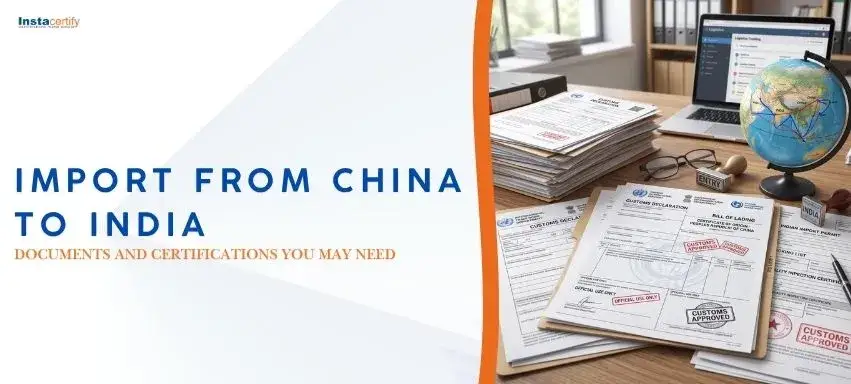
Once the goods are ready to ship, you will also need the normal import and customs paperwork. The exact set can vary with the shipment, product and mode of transport.
- Commercial Invoice
- Packing List
- Bill of Lading or Airway Bill
- Bill of Entry
- Purchase order or sales contract, where applicable
- Certificate of Origin, where required
- Insurance documents, where applicable
- Product catalogue, datasheet or technical details when needed
- Copies of applicable registrations or certificates
A customs broker can handle much of the filing, but the importer should know what is being filed and whether the product needs a separate approval. Customs clearance does not replace a product certification that is required for sale in India.
EPR Plastic Packaging
If your imported goods are covered by India's plastic packaging rules, EPR can become an important part of the import process. This is particularly relevant when you bring packaged products into India and place them on the Indian market.
For the fee figures used in this guide, the government registration fee is taken as ₹10,000 and consultant charges are commonly around ₹6,000–₹8,000, depending on the filing work.
Do not assume that every importer needs the same EPR registration. Check the product, packaging and your role as an importer before applying.
EPR E-Waste
Importing an electronic product can bring another set of responsibilities. If the product falls within the categories covered by India's e-waste rules, the importer may need EPR registration and related compliance.
For the fee figures used here, the government registration fee is ₹10,000 and consultant charges may be around ₹6,000–₹8,000. The actual requirement depends on the product category and the rules applicable at the time of import.
LMPC Registration for Imported Packaged Goods
LMPC, commonly used for Legal Metrology requirements relating to packaged commodities, is something importers of consumer products should check early.
If you import a pre-packaged product and intend to sell it in India, the package may need specific declarations. Depending on the product, these can include importer details, MRP, net quantity, country of origin and consumer-care information.
The government fee is generally around ₹500 for the registration referred to here. Consultants may charge approximately ₹4,000–₹6,000 depending on the work involved.
One practical tip: check the label before the Chinese factory prints thousands of boxes. Changing packaging after production can cost much more than checking it beforehand.
BIS Certification – Check Before You Place the Order
BIS is one of the most important checks for many imported electrical, electronic and other regulated products. But BIS is not required for every product.
The important question is whether your exact product is covered by a mandatory Quality Control Order (QCO) or another compulsory BIS requirement.
Do not rely only on your Chinese supplier saying that the product is 'CE certified' or meets international standards. Those documents may be useful, but they do not automatically satisfy an Indian mandatory BIS requirement.
WPC for Wireless Products
If your product has Wi-Fi, Bluetooth, radio or another wireless/RF function, check WPC requirements before importing it.
The exact route depends on the wireless technology, frequency and device category. A product that looks simple from a commercial point of view can still require an Indian approval because it uses radio frequency.
CDSCO for Medical Devices and Cosmetics
Medical devices and certain cosmetics can come under CDSCO and related Indian regulatory requirements. The product should be classified before you decide how to import it.
Do not wait until the shipment reaches India to find out that the product needs a registration or licence. Get the classification and import route checked first.
BEE and Other Product Requirements
Some energy-using products may also have requirements under the Bureau of Energy Efficiency (BEE). Other products can have requirements from different Indian authorities.
Requirement | Products where it may matter | What to check |
BEE | Specified appliances and energy-using products | Whether the exact model is covered |
Battery EPR | Batteries and products containing covered batteries | Battery category and applicable EPR duties |
FSSAI | Food and certain food-related products | Food category and import requirements |
TEC | Certain telecom equipment | Applicable technical requirements |
IMEI / related telecom requirements | Certain cellular / mobile devices | Whether registration is required for the device |
Simple Way to Check a Product Before Importing
Before you send an advance payment to a Chinese supplier, run through this list:
- Have a valid IEC.
- Confirm the product name, model and intended use.
- Find the correct HS classification with your customs professional.
- Check whether the product is covered by a BIS/QCO requirement.
- Check LMPC if it will be sold as a pre-packaged consumer product.
- Check EPR Plastic if applicable.
- Check EPR E-Waste if the product is covered.
- Check Battery EPR where applicable.
- Check WPC if the product has wireless/RF functions.
- Check CDSCO for medical devices and applicable cosmetics.
- Check BEE for covered energy-using products.
- Check the Indian label requirements before packaging is printed.
- Keep the invoice, packing list, shipping documents and applicable certificates ready for customs.
Example: Importing a Wireless Consumer Electronic Product
Suppose you are buying a Bluetooth-enabled consumer device from a factory in China. You cannot stop the check at the IEC stage.
You would first check your IEC and customs setup. Then check whether the product is covered by BIS requirements, whether its packaging creates LMPC or plastic EPR obligations, whether the product is covered by e-waste rules and whether its wireless function requires WPC approval.
The point is simple: the same importer can legally bring one product into India with a relatively small compliance burden and need several registrations for another product.
Import from China to India: Don't Find Out About Compliance After Shipment
The expensive mistake is usually not the registration fee. It is ordering the wrong product, printing packaging that cannot be used, or discovering a mandatory certification after the goods have already left China.
Spend a little time checking the product before you place the order. Ask for the complete model number, technical specification, photographs of the product and packaging, wireless details if applicable, and the supplier's existing test reports or certificates.
Read Our Detailed China Import Compliance Guide
We have also published a more detailed guide covering importing from China, compliance certifications and practical alternatives. Use that article as the next internal link for readers who want a deeper look at China import compliance.
Suggested internal-link anchor: China import compliance and certification guide
Not Sure Which Certification Your Product Needs?
If you have a product in mind but are not sure whether it needs BIS, LMPC, EPR, WPC, CDSCO, BEE or another approval, it is better to check before ordering.
Instacertify provides certification and compliance consulting for imported products. The consultation is normally valued at ₹4,999 and is currently offered at ₹499 as a consultation offer. An expert can review your product and help you understand which Indian certifications and registrations you should check before importing.
Frequently asked questions
What documents are required to import from China to India?
A commercial importer generally starts with a valid IEC and the usual customs and shipping documents such as the commercial invoice, packing list, Bill of Lading/Airway Bill and Bill of Entry. Additional certificates or registrations depend on the product.
Is IEC required for importing from China to India?
A valid IEC is the basic requirement for most commercial imports. Make sure it is active before you start the import.
How much does an IEC cost in India?
The government fee for a new IEC is generally ₹500. Consultant assistance may cost around ₹2,000–₹2,500.
Do I need EPR Plastic when importing from China?
It depends on the product and packaging and the applicable plastic-waste obligations. Check this before importing packaged goods.
Do all electronic products need EPR E-Waste?
No. It depends on whether the product falls within the applicable notified categories.
Do I need LMPC for products imported from China?
If you are importing pre-packaged commodities for sale in India, LMPC requirements should be checked before shipment and packaging production.
Does every product imported from China need BIS?
No. BIS is mandatory for products covered by the relevant compulsory requirements. The exact product and model need to be checked.
What should I check before placing an order with a Chinese supplier?
Check IEC, HS classification, customs requirements and product-specific requirements such as BIS, LMPC, EPR, WPC, CDSCO and BEE where applicable.