
Global Compliance
Indian Importer’s Guide to Importing from China: Compliance, Certifications & Practical Alternatives (2026)
To import from China to India you need an Importer Exporter Code (IEC), the product approvals that apply to your goods (BIS, WPC, LMPC, EPR and others), and a complete set of shipping documents: commercial invoice, packing list, bill of lading or airway bill, and a bill of entry filed with Indian Customs. The seven steps, the documents checklist and the approvals by product category are below.
How to import from China to India in 7 steps
- Get your IEC. Apply on the DGFT portal with the PAN of your business. It is issued online, and you cannot import commercially without it. See IEC registration.
- Check the product’s approvals before you pay the supplier. Find the HS code, then check whether it needs BIS CRS registration or an ISI licence, WPC ETA approval, TEC, LMPC registration, EPR, FSSAI or CDSCO. Most stuck shipments start here.
- Register on ICEGATE if you will file yourself. ICEGATE registration lets you file and track customs documents online. Many importers let a licensed customs broker file for them instead.
- Agree terms with the supplier. Fix the Incoterm (FOB, CIF or EXW), the payment method, and the labelling your goods need for India: importer name and address, MRP and the other Legal Metrology declarations.
- Book freight and insurance. A freight forwarder arranges sea (FCL or LCL) or air shipment and issues or collects the bill of lading or airway bill.
- File the bill of entry and pay duty. The bill of entry is filed on ICEGATE, customs assesses duty on the assessable value, and duty is paid online.
- Clear and take delivery. If the shipment is selected for examination, customs checks the goods against your documents. After the out-of-charge order, the goods leave the port or container freight station.
Documents required to import from China
| Document | Who provides it | Why customs needs it |
|---|---|---|
| Commercial invoice | Chinese supplier | Shows the value, currency and terms on which duty is assessed |
| Packing list | Chinese supplier | Quantities, weights and package marks, used during examination |
| Bill of lading or airway bill | Shipping line, airline or forwarder | Proof of shipment and title to the goods |
| Bill of entry | Importer or customs broker, on ICEGATE | The customs declaration for the import |
| IEC | Importer, from DGFT | Required for every commercial import |
| Product approvals | Manufacturer or importer | BIS registration or licence, WPC ETA, LMPC, EPR, FSSAI or CDSCO, where the product needs them |
| Certificate of origin | Supplier or a Chinese issuing body | Needed to claim a preferential duty rate, for example under the Asia-Pacific Trade Agreement, or when customs asks |
| Insurance certificate and payment proof | Insurer and bank | Supports the declared value |
Certifications by product category
| Product category | What usually applies in India |
|---|---|
| Electronics and IT (chargers, adapters, laptops, LED lights, power banks) | BIS CRS registration with an R-number for listed products; WPC ETA for Wi-Fi or Bluetooth; TEC (MTCTE) for telecom equipment; e-waste EPR; LMPC for retail packs |
| Toys | BIS ISI licence under IS 9873 and IS 15644, held by the manufacturing factory |
| Steel products | BIS ISI licence for grades covered by the steel Quality Control Orders, held by the mill |
| Chemicals and polymers | BIS ISI where a Quality Control Order covers the chemical (the list changes often, so check it for your HS code), MSDS, and plastic EPR for packaging |
| Food and food ingredients | FSSAI Central licence for importers and FSSAI import clearance for each consignment |
| Cosmetics and medical devices | CDSCO import registration or licence |
| Batteries | BIS CRS registration for listed cells and batteries, and battery EPR |
| Packaged consumer goods | LMPC importer registration and correct label declarations |
Can you import any product from China?
No. Most goods are free to import under India’s ITC (HS) import policy, but some are restricted and need a DGFT import authorisation, some are prohibited, and a few can only be imported through state trading enterprises. Check the policy condition for your HS code before you order.
A product that is free to import can still need a product approval (BIS, WPC, FSSAI and so on) and can attract anti-dumping duty, which India applies to many Chinese goods. Second-hand goods, such as used electronics and machinery, have their own conditions.
Common reasons shipments get stuck at customs
- The model, brand or factory is not covered by the BIS registration or licence, or the BIS mark and R-number are missing from the product.
- A radio product has no WPC ETA, or a telecom product has no TEC certificate.
- Retail packs lack Legal Metrology declarations such as the importer’s name and address, MRP or net quantity.
- The declared value is lower than customs expects, or the HS code is wrong.
- Anti-dumping duty applies and was not provided for.
- The importer has no EPR registration for plastic packaging, e-waste or batteries.
- Food samples fail, or labels do not meet FSSAI rules.
- The invoice, packing list and bill of lading do not match each other.
Importing products from China into India remains a strong sourcing option, but regulatory compliance now determines how smoothly your goods enter the Indian market. Customs authorities, regulators, and marketplaces expect importers to be fully aligned with documentation, safety, environmental, and labeling requirements. This guide explains mandatory registrations, EPR certification and its types, LPMC, IEC & ICEGATE, and practical solutions when BIS certification is delayed or not granted under current policy conditions.
Why Compliance Is Critical When Importing from China
Indian regulators actively enforce:
- Quality Control Orders (QCOs)
- Product safety standards
- Consumer labeling rules
- Environmental responsibility obligations
Non-compliance can result in:
- Shipment detention at port
- High demurrage and penalties
- Re-export or destruction of goods
- Restrictions on future imports
Compliance planning should start before finalizing suppliers or placing purchase orders.
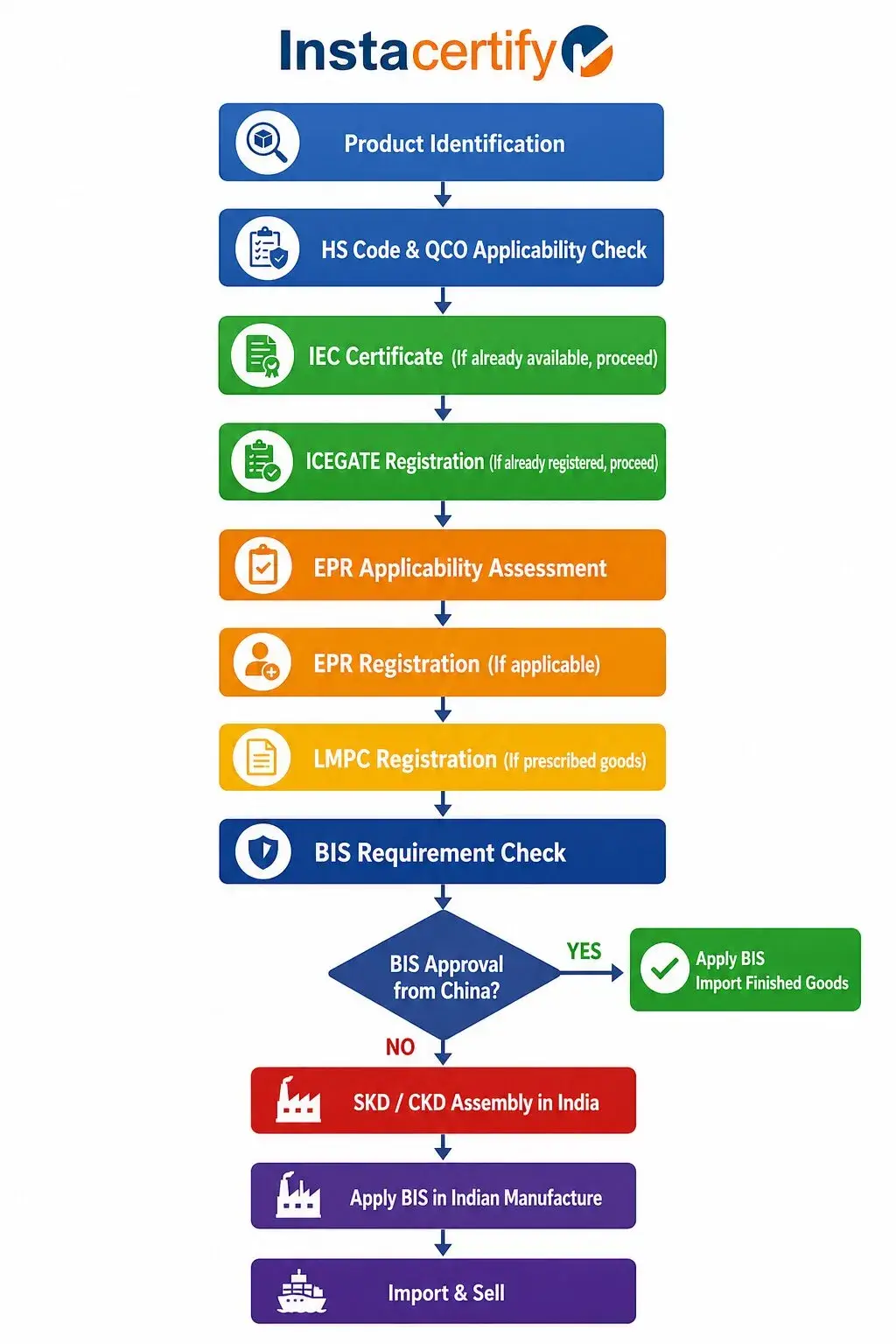
Mandatory Registrations & Certifications for Indian Importers
IEC Certificate (Importer Exporter Code)
The IEC Certificate, issued by DGFT, is mandatory to import goods into India. If you already have an IEC, you are already compliant on this requirement—no additional action is needed. IEC is required for:
- Importing commercial goods
- Customs clearance
- Foreign remittance through banks
ICEGATE Registration
ICEGATE (Indian Customs Electronic Gateway) registration enables digital interaction with Indian Customs. If you already have ICEGATE registration linked to your IEC, this step is already completed. ICEGATE allows:
- Online filing of Bills of Entry
- Electronic duty payments
- Real-time tracking of shipment clearance
IEC and ICEGATE together form the core infrastructure for Indian imports.
LPMC Certification (Legal Metrology – Packaged Commodities)
LPMC registration is mandatory if you are importing pre-packed goods, including:
- Electronics and IT products
- Electrical appliances
- Toys, lighting products, accessories
Mandatory label declarations include:
- Importer name and address
- MRP (₹ inclusive of all taxes)
- Net quantity
- Country of origin
- Consumer care details
Incorrect labeling commonly leads to customs detention or mandatory relabeling at port.
EPR Certification in India & Its Types
Under Extended Producer Responsibility (EPR) regulations, importers are legally treated as producers. Types of EPR Certification:
E-Waste EPR
For electronics, IT equipment, chargers, adapters
Plastic Waste EPR
For plastic and multilayer packaging materials
Battery Waste EPR
For lithium-ion, portable, and industrial batteries EPR compliance involves:
- Registration on CPCB portal
- Meeting annual recycling targets
- Engagement with authorized recyclers
BIS Certification: Current Challenges for Imports from China
Many products imported from China require mandatory BIS certification under:
- CRS (Compulsory Registration Scheme)
- ISI Mark Scheme
Current Scenario
- New BIS approvals for China-based factories are highly restricted
- Factory inspections face prolonged delays
- Applications may remain pending for extended periods
This has become a major bottleneck for importers.
What Can Importers Do If BIS Certification Is Not Available?
Option 1: SKD / CKD Imports with Assembly in India (Most Effective)
SKD (Semi Knocked Down) and CKD (Completely Knocked Down) imports allow importers to:
- Import components instead of finished goods
- Assemble or manufacture in India
- Apply for BIS certification as an Indian manufacturer
Advantages:
- Faster BIS approval timelines
- Reduced certification costs
- Better compliance control
- Long-term brand ownership
- Strong alignment with Make in India initiatives
Option 2: Source from Alternate Countries
If SKD/CKD assembly is not feasible:
- Shift sourcing to Vietnam, Thailand, Malaysia, Taiwan, or Indonesia
- Apply for BIS certification for non-China manufacturing units
This approach suits importers seeking fully finished products with fewer regulatory delays.
Option 3: Import Using an Existing BIS Certificate (Limited Scope)
Importers may partner with an entity that already holds a BIS certificate. Important limitation under CRS:
- New brands cannot be added
- Products must be sold under the existing registered brand
This option is generally viable only for short-term market testing.
Do you want to import products from China without compliance delays? Instacertify helps businesses obtain IEC, BIS, EPR, LMPC, and other mandatory certifications for hassle-free imports into India.
Frequently asked questions
What documents are mandatory before importing products from China into India?
Before importing commercially, businesses generally need an IEC, ICEGATE registration, GST registration, and product-specific approvals such as BIS, EPR, or LMPC depending on the product category. Completing these requirements in advance helps prevent customs delays and ensures smooth import clearance.
Is an IEC certificate compulsory for importing from China?
Yes. An Import Export Code (IEC) issued by DGFT is mandatory for almost all commercial imports into India. Without a valid IEC, customs clearance, international payments, and legal import activities cannot be completed.
Why is ICEGATE registration important for importers?
ICEGATE registration enables importers to interact digitally with Indian Customs by filing Bills of Entry, paying duties online, and tracking shipment status. Linking ICEGATE with your IEC simplifies documentation and speeds up customs clearance.
When is LMPC registration required for imported products?
LMPC registration is required when importing pre-packaged commodities intended for retail sale in India. It ensures mandatory declarations such as MRP, importer details, country of origin, net quantity, and consumer information comply with Legal Metrology regulations.
Is EPR registration mandatory for importers?
Yes. Importers of electronics, batteries, or products with plastic packaging are generally treated as producers under India's Extended Producer Responsibility framework and must obtain the applicable EPR registration before placing products in the market.
Can I import products from China without BIS certification?
Only products that are not covered under applicable Quality Control Orders can be imported without BIS certification. If your product falls under mandatory BIS regulations, the required certification must be obtained before importation.
What is the SKD/CKD alternative for Chinese imports?
SKD (Semi Knocked Down) and CKD (Completely Knocked Down) models allow importers to bring components into India, assemble them locally, and apply for BIS certification as an Indian manufacturer where applicable, offering a practical compliance route.
Can I use another company's BIS certificate for my products?
Generally, no. Under the BIS CRS framework, new brands cannot simply be added to another company's certificate. Products must comply with the specific certification conditions, making this option suitable only in limited situations.
Can I import from China to India as an individual?
Yes. Goods for personal use can be imported without an IEC, subject to customs duty and the baggage or courier rules. To import for sale you need an IEC, which an individual can get as a sole proprietor using their own PAN.
Is BIS needed for all Chinese products?
No. BIS registration or a BIS licence is needed only for products covered by the Compulsory Registration Scheme or by a Quality Control Order. Check your product’s HS code and description against the current lists before you place the order.
How much duty is charged on imports from China?
It depends on the HS code. The usual components are basic customs duty, a social welfare surcharge on that duty, and IGST on the value plus duties, with anti-dumping duty added where it has been notified for the product. The current rates are in the customs tariff on the CBIC and ICEGATE websites.
How long does customs clearance take?
When documents are complete and the shipment is not selected for examination, clearance usually takes a few working days after the goods arrive. It takes longer when goods are examined, when samples are drawn for testing, or when customs raises a query on value or classification.
